

Kazakhstan could earn 41% more
Kazakhstan ranks 43rd out of 162 countries in the World Bank's Human Capital Index and leads Central Asia.
The future of an economy depends not only on oil, factories and roads. It depends just as much on people: how well they learn, how healthy they are, and how fully they use their skills at work. Economists call this human capital, and the World Bank regularly measures it in every country in the world.
In 2026, the World Bank presented its Human Capital Index, HCI+. It estimates the earnings potential a person can accumulate over their working life, given the state of health, education and employment in the country. It is not a forecast of a particular person’s salary or of the country’s income in 20 years, but a model-based estimate: how much the country’s current results in health, education and the labor market help people be productive and earn money, if those results persist.
The index has three components:
- health: for example, the probability of surviving to age 60 and the share of children with stunted growth;
- education: how many years a person studies, how well they absorb knowledge, and whether they get a higher education;
- employment and on-the-job learning: labor force participation, unemployment and the share of wage employment, that is, how much opportunity people have to apply and develop their skills.
• Kazakhstan scored 229.8 out of 325 points and ranked 43rd out of 162 countries, first in Central Asia.
• We are above the average for countries with a similar income level, but below the average for Europe and Central Asia.
• We lag furthest behind in education, which accounts for 18 of the 27-point gap with Germany.
• According to the World Bank, if lagging indicators were brought up to the level of the best countries with similar GDP per capita, Kazakhstanis’ earnings potential could grow by 41%.
Where Kazakhstan ranks
Kazakhstan scored 229.8 points on the index. We ranked all 162 countries for which the World Bank database has HCI+ values for the latest year, and Kazakhstan came 43rd. Some media also report 42nd place out of 161 countries: the difference depends on which countries and territories are included. Next to us are Serbia, Qatar and Turkey. Ahead are Russia (248.8), Belarus (250.4) and Poland (259.1). The leaders are Japan and Singapore, with more than 280 points.
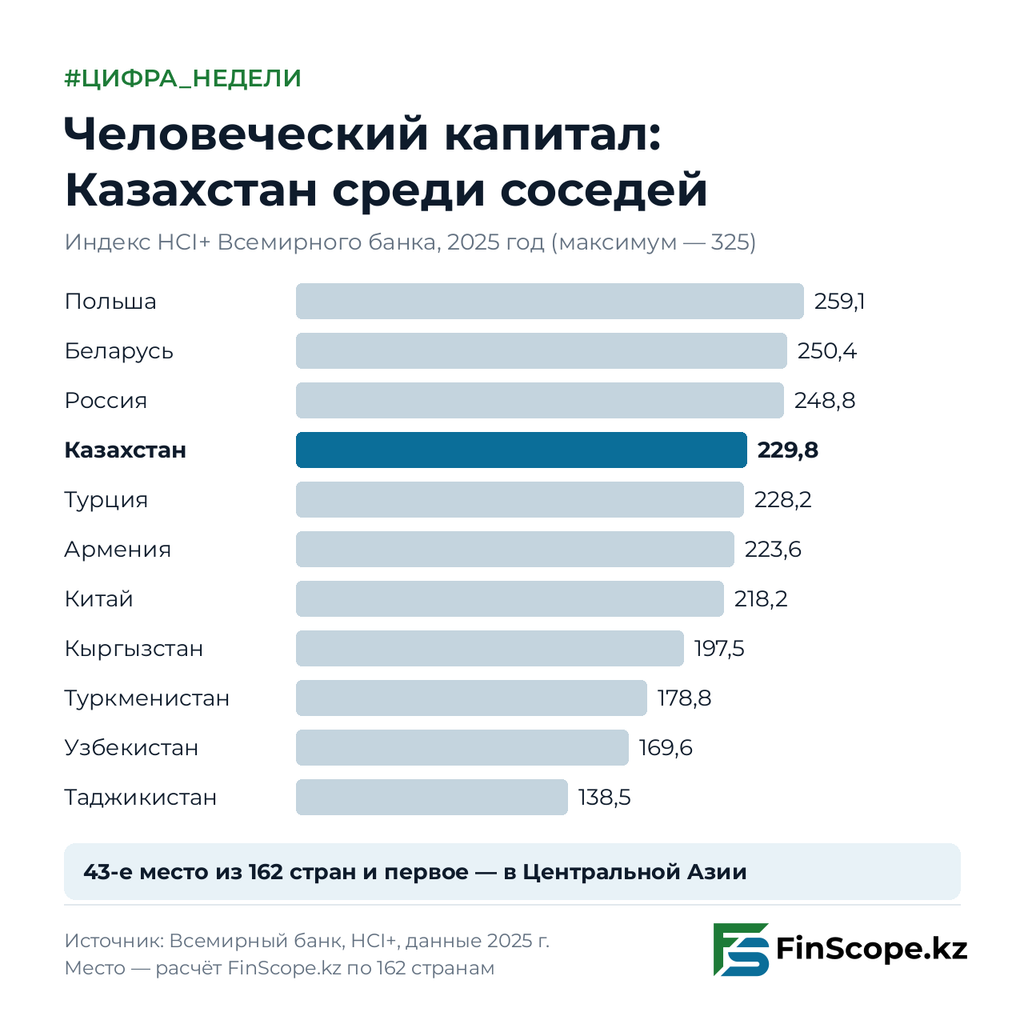
For its income level, Kazakhstan looks good: upper-middle-income countries average 204 points, and we are well above that. In Central Asia, the lead is even larger: Kyrgyzstan has 197.5 points, Uzbekistan 169.6, and Tajikistan 138.5. But the average for Europe and Central Asia is 240 points, and Kazakhstan has yet to reach it.
Where we lag behind and where we lead
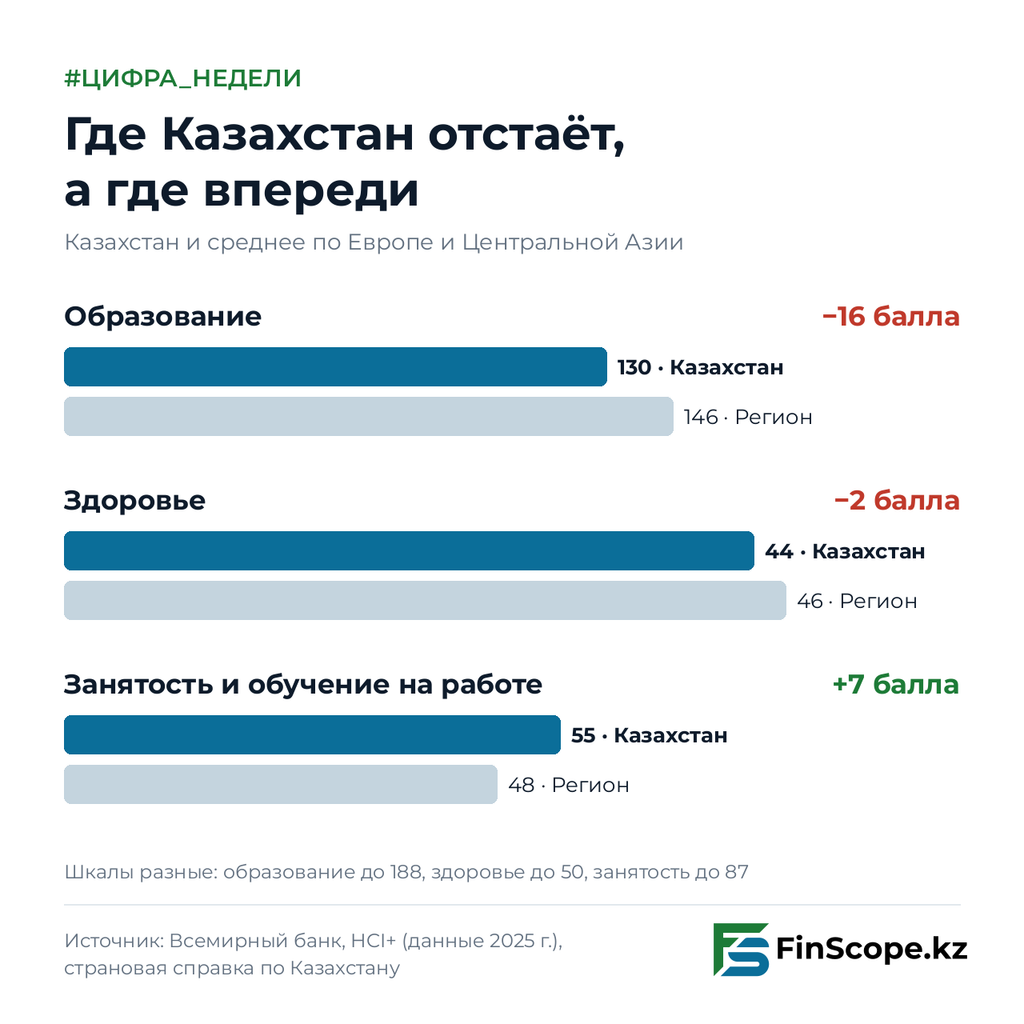
| Component | Kazakhstan | Europe and Central Asia | Difference |
|---|---|---|---|
| Education (out of 188) | 130 | 146 | −16 |
| Health (out of 50) | 44 | 46 | −2 |
| Employment and on-the-job learning (out of 87) | 55 | 48 | +7 |
| Overall index (out of 325) | 230 | 240 | −10 |
Employment is our strength. On this component, Kazakhstan is above the regional average. If all 162 countries were ranked on this component alone, Kazakhstan would be 24th, between the United Kingdom and Singapore. This component reflects how engaged people are in the labor market: labor force participation, unemployment and the share of wage employment. The higher these indicators, the more opportunities people have to apply their skills and gain experience.
Health is almost at the regional level, with a gap of just 2 points.
Education is the main weakness. The gap here is 16 points, and this is what pulls the index down.
An interesting detail: in Kazakhstan, women score higher on the index than men, 230 versus 227 points. According to the Bank, this means women’s earnings potential is 3% higher.
Many years of school, but less knowledge than years
Why education lags behind is clearly visible in data from the previous version of the index, HCI 2020 (these indicators are not published separately in the new index). A child in Kazakhstan studies for almost 14 years on average, from pre-school preparation to the end of school. That is the same as in Russia and more than in Poland. But the World Bank adjusts years of schooling for international test results: how many years of schooling the acquired knowledge would be “worth” if children learned as effectively as in the leading countries. With this adjustment, Kazakhstan’s 14 years are equivalent to about 9. In Poland, it is more than 11.
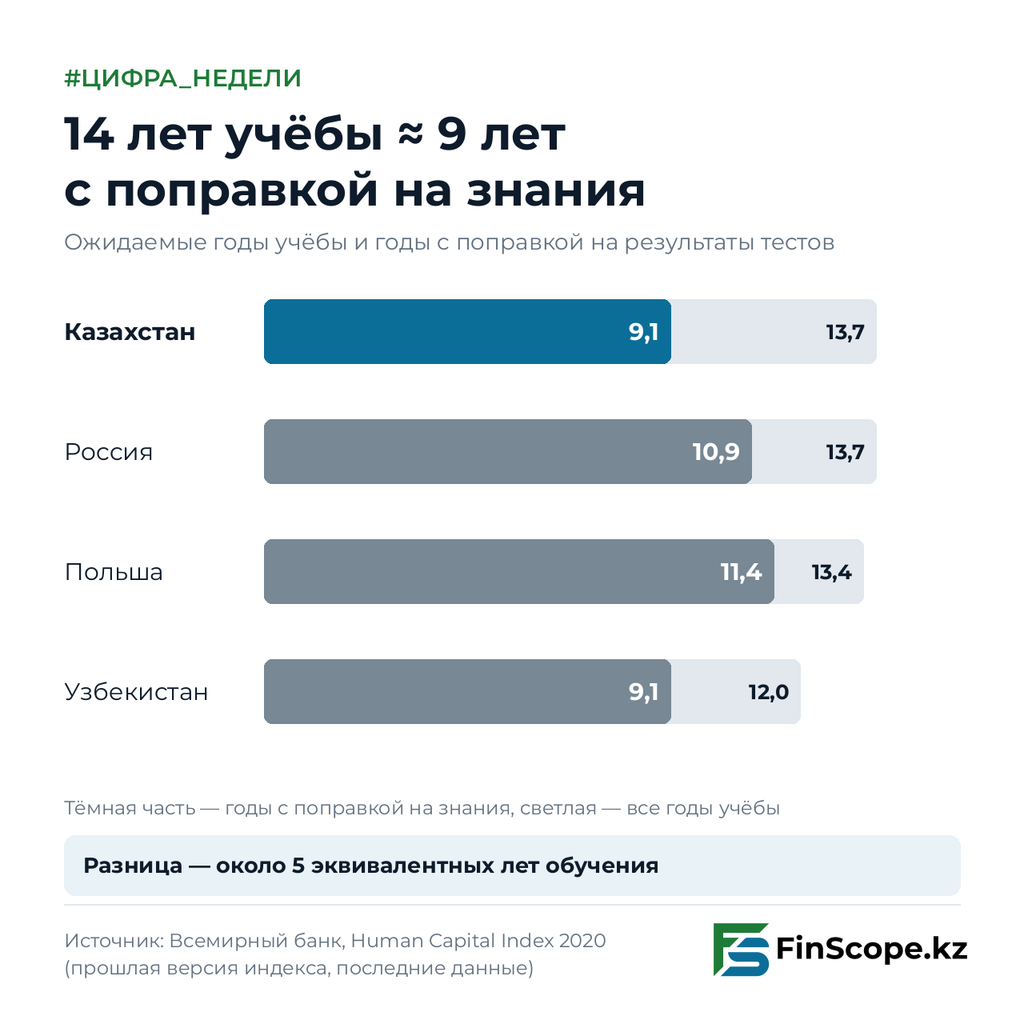
The difference is about five equivalent years of schooling. This does not mean children literally lose five years at school. It means that in the same time they learn less than they could. The problem is not the quantity of schooling but its outcome. This is also visible in the index’s history: in 2018, the previous version rated Kazakhstan at 0.78 out of 1, and in 2020, when the Bank took into account fresh international test results, the score fell to 0.63.
What exactly separates us from developed countries
The World Bank compares Kazakhstan with Germany. The gap is 27 points: 18 are due to education, 5 to health and 4 to employment. Three indicators explain most of this gap:
- learning outcomes: how well children absorb knowledge, based on international tests;
- expected years of schooling: how many years a person spends in education;
- the probability of surviving to age 60: the main indicator of adult health in the index.
In other words, the issue is not some abstract “poor education” but specific things: the quality of school teaching, access to education and the health of working-age people.
More money for education
In recent years, the government has significantly increased spending on education: from 2.8% of GDP in 2017 to 4.9% in 2023. This is already close to the OECD average of 5.1% in 2022. Public spending on healthcare has also grown, from 1.9% to 2.5% of GDP. But here developed countries are still far ahead: in the OECD, governments spend about 8% of GDP on health (2023). Both values are the same World Bank indicator: domestic general government health expenditure, excluding people’s private spending.
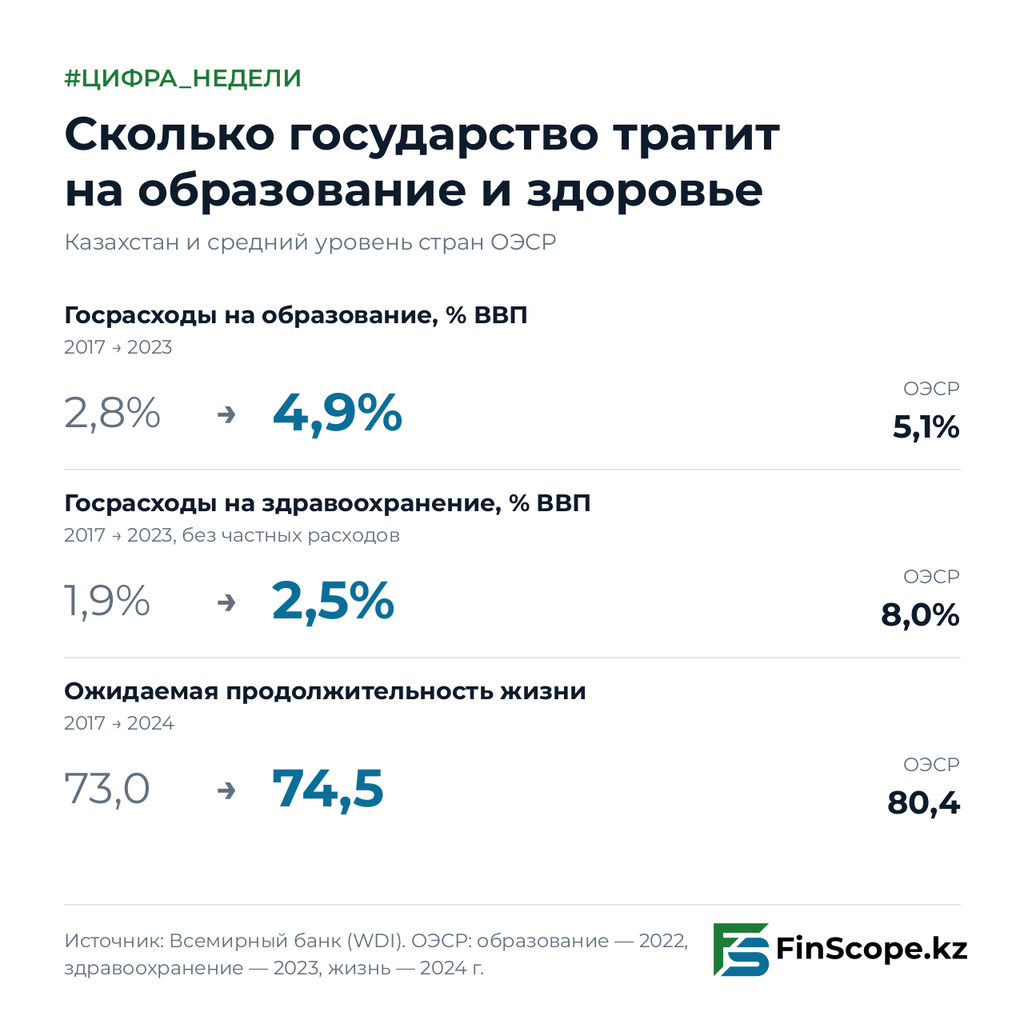
It is important to distinguish two things: increased funding and improved results. More money is a necessary but not sufficient condition. These data cannot tell us how much the higher spending has already affected knowledge and health: human capital changes slowly, and today’s schoolchildren will enter the labor market only in 10–15 years. Life expectancy rose from 73.0 to 74.5 years between 2017 and 2024, but it is still far from the OECD average of 80.4 years.
How much Kazakhstan could gain
The index can be translated into money. The World Bank uses a simplified rule: every 10 additional index points mean roughly 10% higher expected labor income for a person. This is an estimate of earnings potential, not a promise of higher wages.
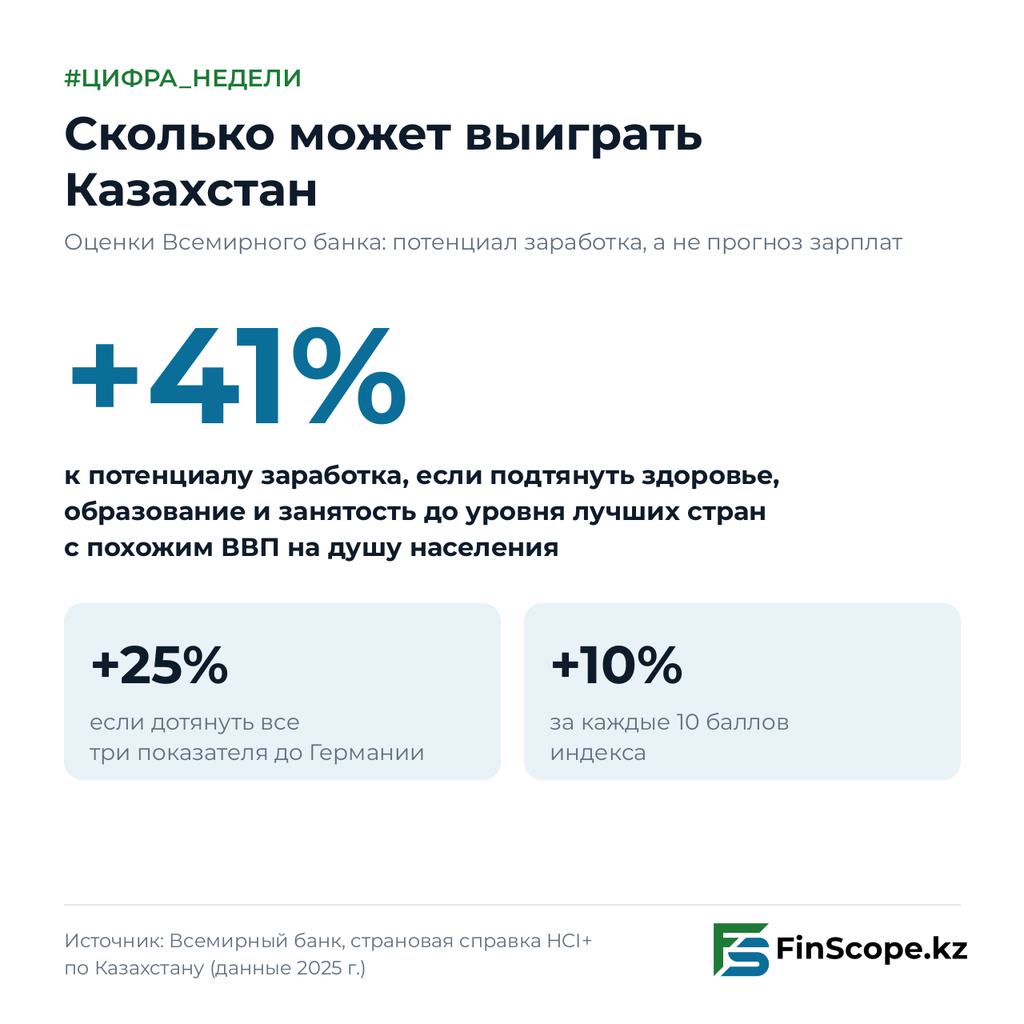
- +41%: this is how much earnings potential could grow if health, education and employment were brought up to the level of the best countries with similar GDP per capita.
- +25%: if all three components were brought up to Germany’s level.
In other words, the biggest reserve for growth is in education. Closing even half of the gap with the regional average would add roughly +8% to earnings potential.
Compare Kazakhstan with other countries
Choose a country to see how many points we are behind or ahead of it, which component has the biggest gap, and roughly what difference in earnings potential this corresponds to.
Source: Human Capital Index Plus, World Bank, latest data in the database (2025), scale 0–325. The difference in earnings potential is based on the World Bank’s simplified rule: 1 index point ≈ 1% of expected labor income. This is a rough estimate of potential, not a forecast of wage growth. FinScope.kz calculator.
FinScope.kz newsletter
New articles and data once a week in your inbox. No spam, unsubscribe at any time.