

Central Asia is the world’s fastest-growing region
Central Asia, five countries with almost 60 million people, produced $66 billion worth of goods and services in a year. Twenty years later, the region's economy had grown to $490 billion.
In 2004, all of Central Asia, five countries with almost 60 million people, produced $66 billion worth of goods and services in a year. That was less than Hungary alone. Twenty years later, the region’s economy had grown to $490 billion: it is now twice the size of Hungary’s and almost on par with Norway’s.
No other region in the world grew as much over this period. But a closer look at the numbers shows that the story is more complicated than “we are growing faster than anyone.” Part of the growth comes from expensive oil and exchange rates. The leader in growth rates is not Kazakhstan. And foreign investors, who chose Kazakhstan for 20 years, took more money out of the country in 2025 than they put in.
The key points in brief:
• Central Asia’s economy grew 7.4-fold in 20 years, the highest among all regions of the world.
• Even excluding prices and exchange rates, the region grew twice as fast as the world: 5.8% a year versus 2.9%.
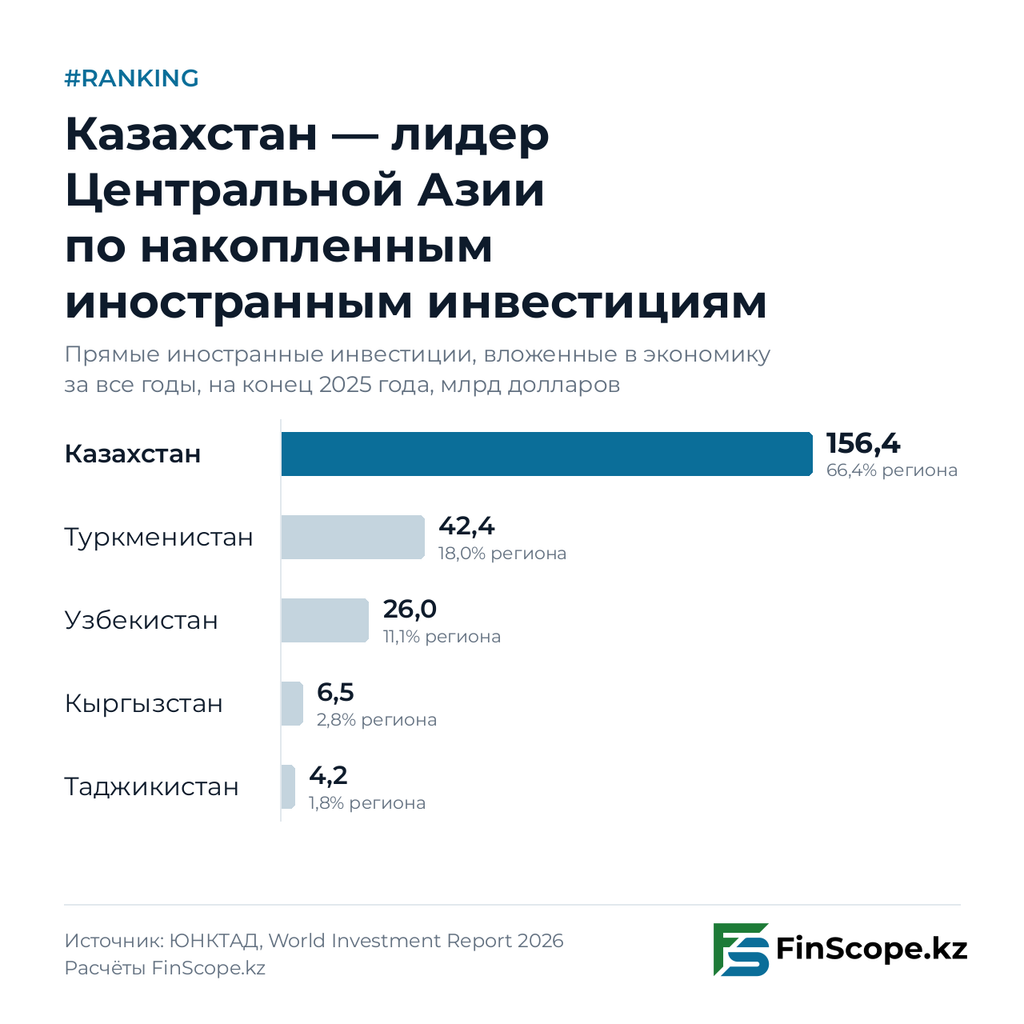
• Kazakhstan accounts for 60% of the region’s economy and has attracted 66% of all its foreign investment.
• But new capital is increasingly flowing to Uzbekistan, while net investment inflows into Kazakhstan turned negative in 2025.
A race few people noticed
When people talk about the fastest-growing economies, they usually think of China, India or Southeast Asia. But if you compare the world’s regions using the World Bank classification, first place over the past 20 years goes to Central Asia.
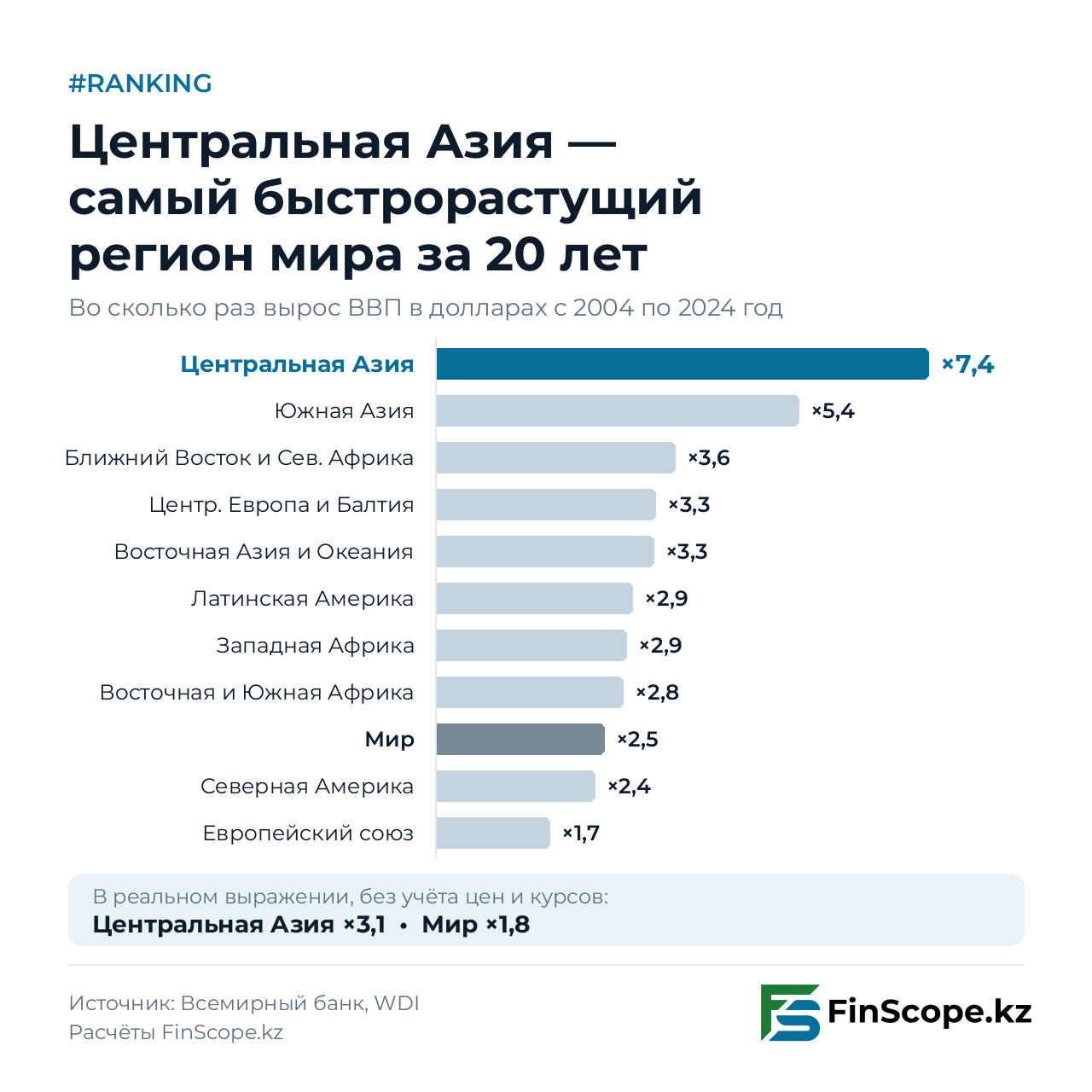
The gap is impressive: the region grew almost three times as much as the global economy and more than four times as much as the European Union. But before drawing conclusions, it is worth asking an uncomfortable question.
How much of this growth is “thin air”
All the figures above are in dollars. And dollar GDP does not grow only when the economy produces more. It also grows when the things a country sells become more expensive and when the national currency’s exchange rate changes. For Central Asia, both effects are huge: the region lives on exports of oil, gas and metals, and the 2000s were an era of commodity boom. We explained in detail how this works using the example of Kazakhstan’s $400 billion GDP.
To separate real growth from price effects, economists calculate real GDP, measured in constant prices. By this measure, the region’s economy grew 3.1-fold, or by an average of 5.8% a year. Over the same period, the global economy grew 1.8-fold, or by 2.9% a year.
The difference between ×7.4 and ×3.1 is precisely prices and exchange rates. But even after removing them, Central Asia grew twice as fast as the world. A comparable pace was seen only in South Asia, where real GDP grew 3.3-fold. So the region’s growth is not a statistical illusion but a reality. It is simply more modest than the headlines suggest.
The growth champion
Within the region, Uzbekistan grew the fastest: its economy expanded tenfold. Kazakhstan grew 6.8-fold, less than Kyrgyzstan and Tajikistan.
| Country | GDP 2004, $ billion | GDP 2024, $ billion | Growth |
|---|---|---|---|
| Uzbekistan | 12.0 | 121.4 | ×10.1 |
| Kyrgyzstan | 2.2 | 18.2 | ×8.2 |
| Tajikistan | 2.1 | 14.4 | ×6.9 |
| Kazakhstan | 43.2 | 291.5 | ×6.8 |
| Turkmenistan | 6.8 | 44.2 | ×6.5 |
| Central Asia | 66.3 | 489.7 | ×7.4 |
This is partly a low-base effect: it is easier for a small economy to grow several times over. But Uzbekistan also has its own story: the country opened up after the 2017 reforms, when the currency was floated and a number of restrictions on business were lifted. At the same time, Kazakhstan remains the economic center of the region, accounting for about 60% of Central Asia’s total GDP.
What it has meant for people
The region’s population grew by 40% over 20 years, from 59 million to 82 million people. The economy grew much faster, so GDP per person rose 5.3-fold, from $1,100 to $6,000 a year. The global average only doubled.
The change is most visible in Kazakhstan. In 2004, GDP per person was $2,700, 2.5 times below the world average. In 2024 it was $14,200, slightly above the world average ($13,700).
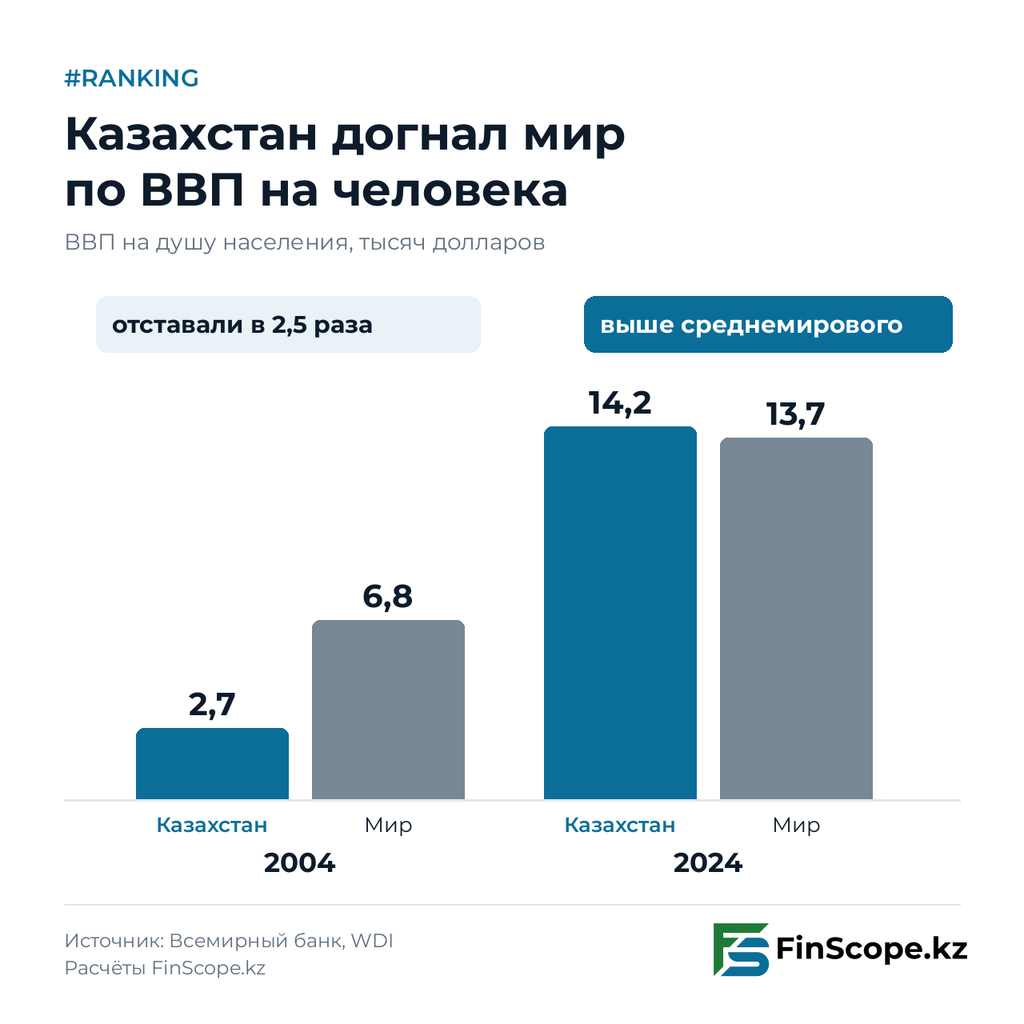
Two caveats matter here. First, these are also dollar figures, so the result depends on the tenge exchange rate. Second, GDP per person is not a salary or income in your pocket, but the average “productivity” of the economy per resident. Still, the direction is clear: within a single generation, Kazakhstan has gone from a country with below-average incomes to one with incomes at the world average.
Kazakhstan: a magnet for capital
Now to investment. Foreign direct investment (FDI) is money that foreign companies put into businesses inside a country: oil fields, factories, banks, trade. FDI stock is the total amount of such investment that is working in the economy today.
According to UNCTAD (the UN agency for trade and development), by the end of 2025 Kazakhstan had accumulated $156.4 billion in foreign direct investment. That is 66% of all FDI in Central Asia, almost twice as much as the other four countries combined. Moreover, Kazakhstan’s share of investment is higher than its share of the regional economy (60%): for twenty years, foreign capital came here more willingly than to its neighbors, primarily into oil, gas and mining.
But new money is going to the neighbors
Accumulated investment is the past. To understand what is happening now, you need to look at annual inflows. And here it is important to distinguish between two figures.
- Gross inflow is how much foreigners invested in the country during the year. In 2025, Kazakhstan received $20.5 billion, 14% more than a year earlier. Sounds great.
- Net inflow is what was invested minus what was withdrawn: loan repayments to parent companies, sales of stakes, projects being wound down. Here Kazakhstan shows minus $0.9 billion. Foreign investors took more money out of the country than they put in.
The main reason is the completion of major oil and gas projects. The phase of large investments is over, and investors have moved on to recovering their money. This is not a disaster: that is how the life cycle of any large project works. But it does mean that the model Kazakhstan used to attract investment for 20 years is running out of steam.
Meanwhile, Uzbekistan leads the region in net inflows, with $4.4 billion in 2025. Its population is 1.8 times larger (36 million versus 21 million), its labor is cheaper, and it still has many untapped niches. For an investor looking for a growing market rather than an oil field, these are strong arguments.
What follows from this
First. Central Asia’s growth is real: even excluding prices and exchange rates, the region grew twice as fast as the world for two decades. But the dollar figures contain a lot of “commodity air,” which could disappear just as quickly if oil and metal prices fall or currencies weaken.
Second. Kazakhstan is the region’s largest economy and its main recipient of investment, and it has reached the world average in GDP per person. This foundation will not disappear overnight.
Third. The next 20 years will be different. Competition for capital is no longer between Central Asia and the rest of the world, but within the region itself. To remain the leader, Kazakhstan needs large projects beyond oil and gas: in processing, logistics and technology. Otherwise, the role of the region’s main investment hub may gradually pass to Uzbekistan.
FinScope.kz newsletter
New articles and data once a week in your inbox. No spam, unsubscribe at any time.