

Without strong schools, Kazakhstan could miss out on 11% of GDP
In 2007, Kazakhstan's schoolchildren ranked 5th in the world in maths. Sixteen years later they were 41st. Over that time the country changed several education programmes, built new schools and raised teacher pay. So why has none of this led to a comparable gain in knowledge?
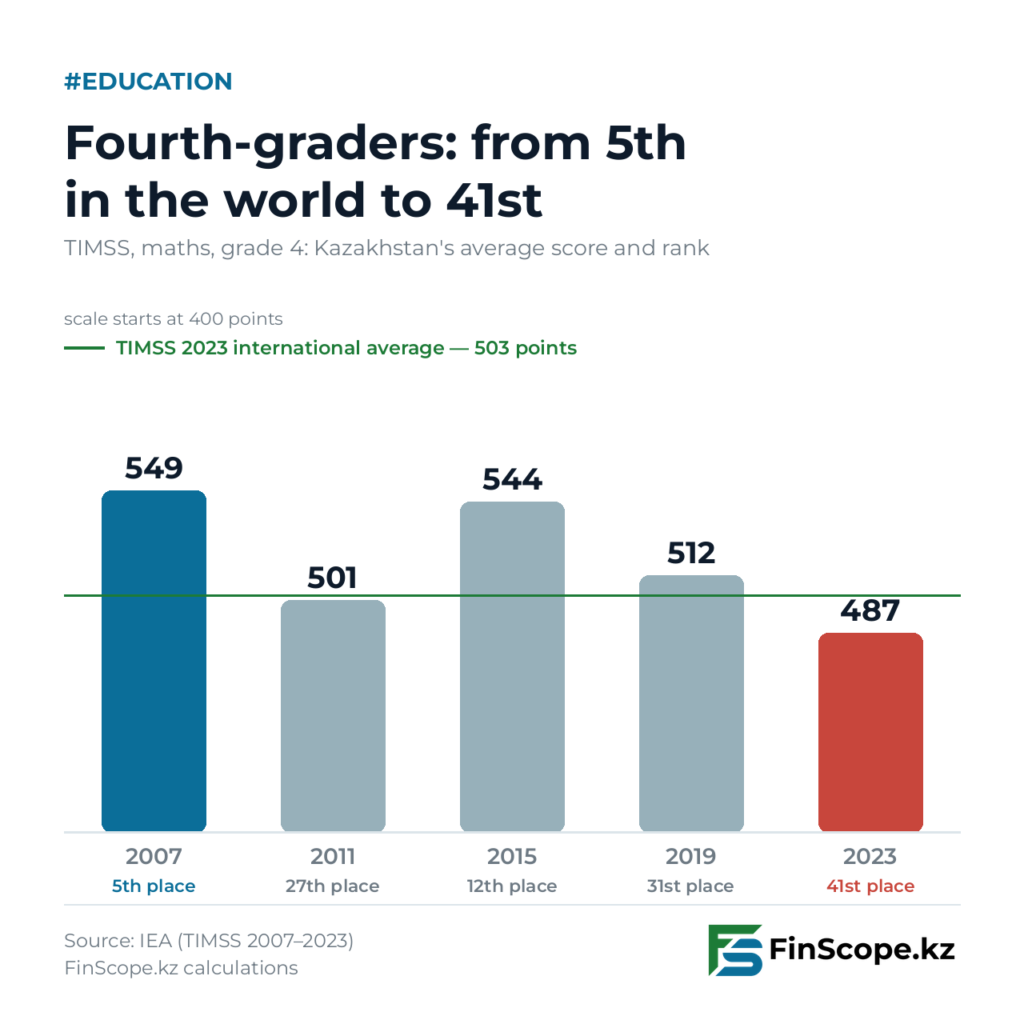
In 2007, Kazakhstan’s schoolchildren joined the world’s elite: in the international TIMSS study, its fourth-graders ranked 5th in maths out of 36 countries. In 2023 they ranked 41st out of 58. In between, schools were reformed almost without pause, more than a thousand new buildings went up and teacher pay was doubled. Yet international test results did not improve, and on several measures they fell.
This is not just a question of education. What a child learns at school is the foundation of future wages, productivity and economic growth. We look at what school reforms promised, why schools did not get better despite all the changes, and where our estimate comes from.
Twenty years of reform: what the state promised
The flagship school reform was meant to be the move to 12-year schooling. The Education Development Programme for 2005–2010 provided for a phased transition: as early as the 2010–2011 school year, first-graders were supposed to study under the new curricula.
The programme for 2011–2020 moved the full transition to 2020, citing emergency and makeshift school buildings, three-shift teaching and a lack of equipment. The same programme set quality targets: by 2020, to rank 40th–45th in PISA and 10th–12th in TIMSS.
In January 2015, Education and Science Minister Aslan Sarinzhipov announced that the move to 12-year schooling was being postponed, with the timing “not yet determined”. The experiment, involving about 400 pupils, was wound up. Instead of changing the structure, from 2016 schools began switching to an updated curriculum based on the experience of Nazarbayev Intellectual Schools.
After that, reforms followed one after another. In 2019 the Teacher Status Law was passed, along with a new State Programme for 2020–2025, but less than two years later it was replaced by the “Educated Nation” National Project, which itself was repealed from 2024.
In 2022 the Ministry of Education and Science was split, and schools came under the new Ministry of Education.
In 2023 the government approved the Concept for the Development of Education to 2029.
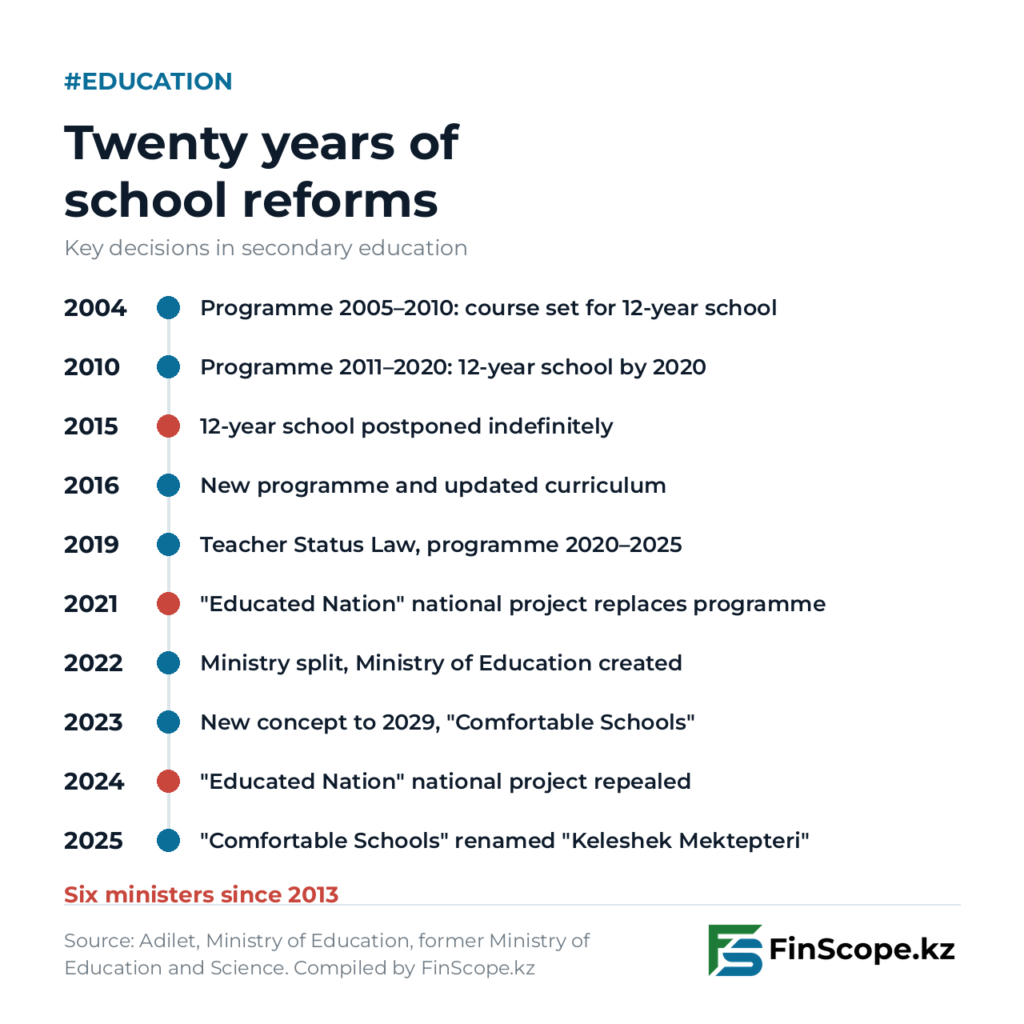
Each of these reforms required teachers to adapt, but none lasted long enough for its results to be fairly assessed.
What changed: schools and salaries
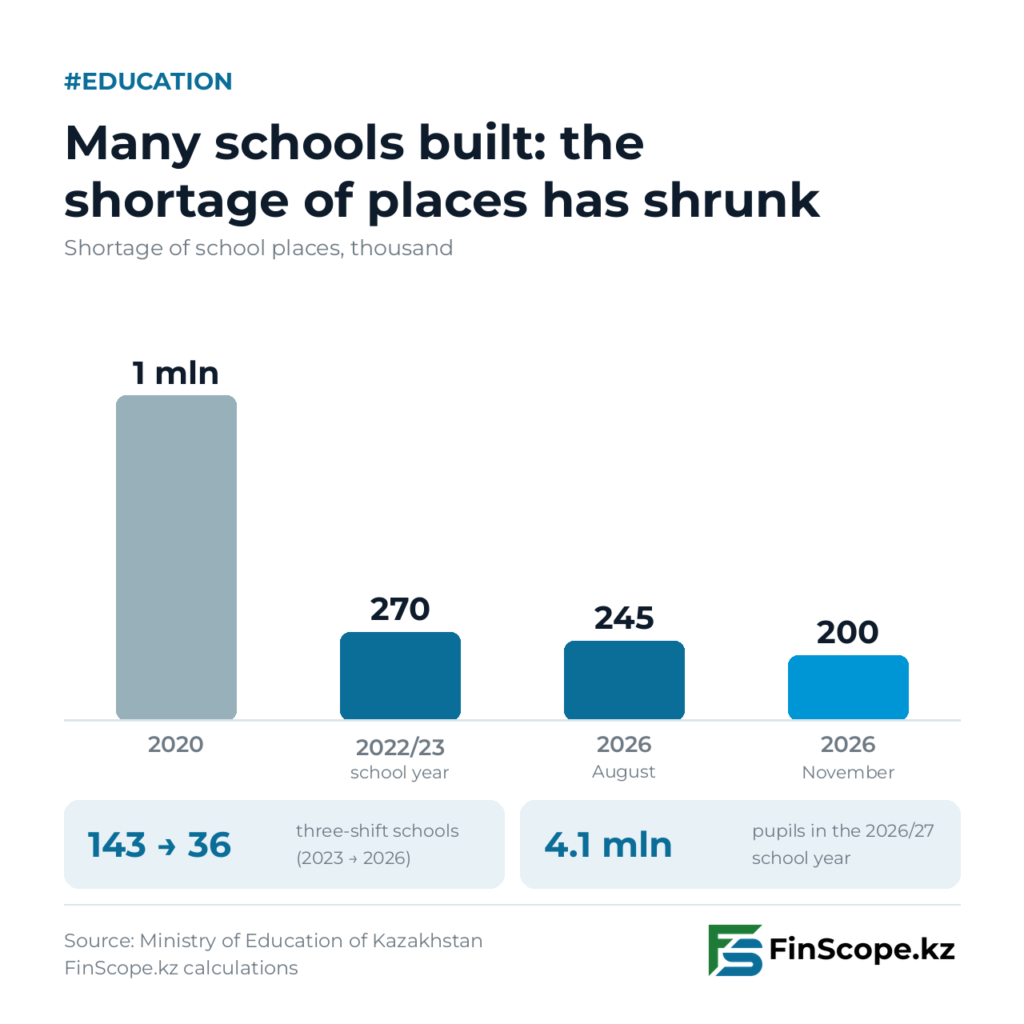
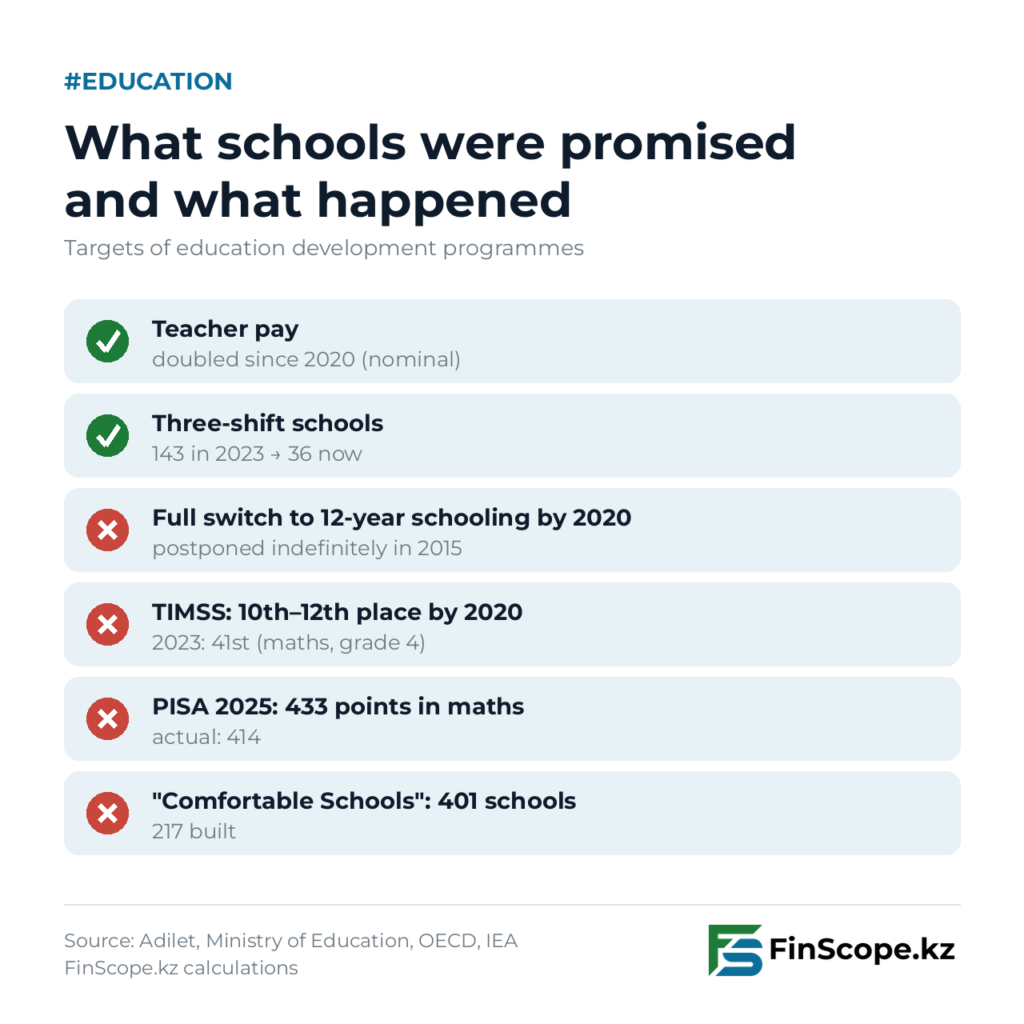
It would be unfair to say the reforms achieved nothing. The most visible result is infrastructure. Over the past seven years the country has built 1,342 schools with more than a million pupil places. The shortage of places, estimated at a million in 2020, had fallen to 200,000 by November 2026. According to the 2023 concept, there were 143 three-shift schools; now there are 36.
A great deal had to be built because the number of pupils grew sharply: about 2.5 million children were in school in 2010–2011, and more than 4.1 million in 2026–2027. Construction was necessary, and the system is still catching up with demographics. But not everything went to plan: the “Comfortable Schools” national project, now called “Keleshek Mektepteri”, originally envisaged 401 schools with 842,000 places, while 217 schools with 460,000 places have been built.
The second change is teachers. The Teacher Status Law banned diverting them to non-teaching work and unnecessary paperwork. According to the Ministry of Education, teacher salaries have doubled since 2020 — in nominal terms, without adjusting for inflation. In 2024 the average salary for one full-time position was 352,000 tenge in cities and 435,000 tenge in rural areas. At the same time, half of all teachers work 1.5 positions: a significant part of their income still comes from a heavier workload.
Why schools did not get better
The main result of a school is what pupils know and can do. International studies do not assess schools as a whole, but they do make it possible to compare how well children have mastered basic knowledge. And here the picture is worrying.
TIMSS: knowledge has been falling since 2015
TIMSS tests maths and science in grades 4 and 8. Rankings across cycles should be compared with caution — the number of participants changes — so scores matter more.
Fourth-graders scored 549 points in maths in 2007, 544 in 2015, 512 in 2019 and 487 in 2023 — below the participant average (503).
Eighth-graders fell from 528 points in 2015 to 488 in 2019 and 454 in 2023.
The Ministry of Education attributed the 2023 decline to the pandemic and to the test being taken on computers for the first time. But the decline began before the pandemic.
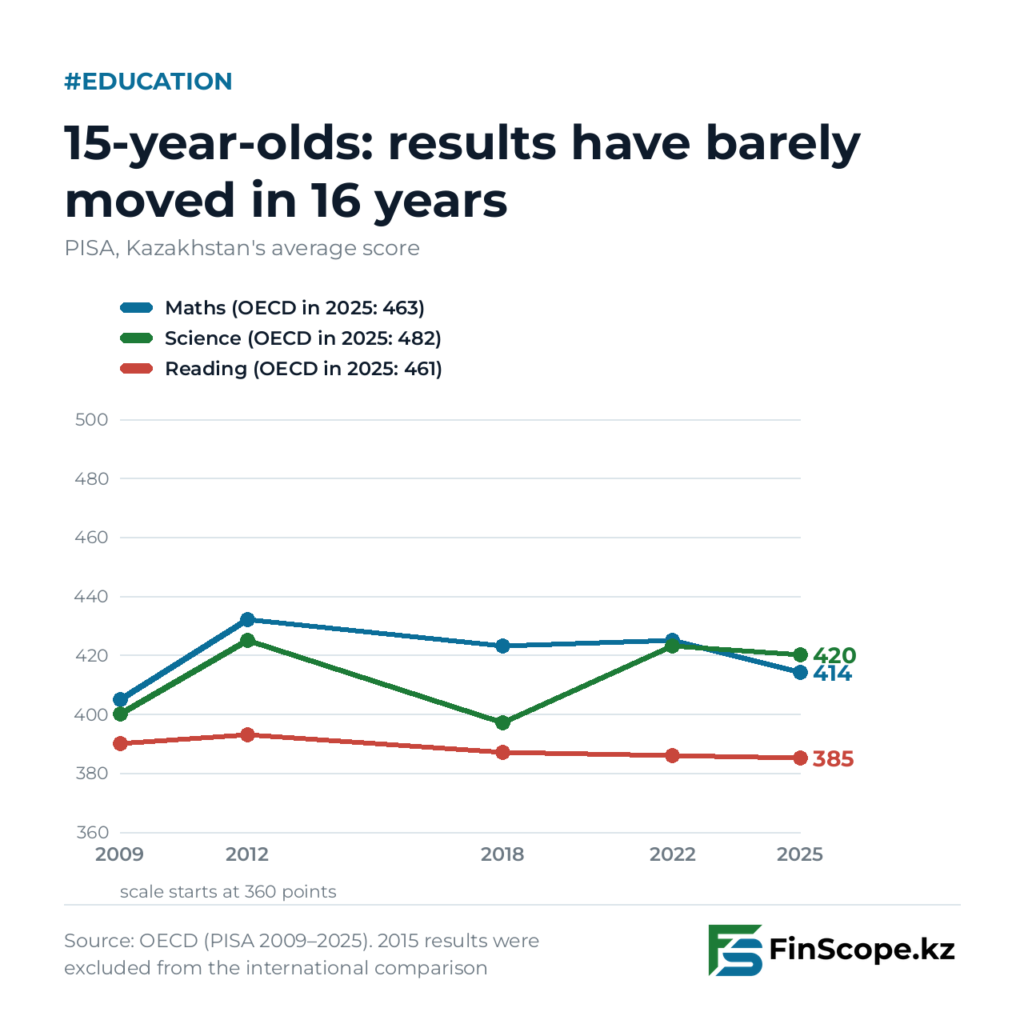
PISA: 16 years standing still
PISA tests how 15-year-olds apply their knowledge in real-life situations.
- In reading, Kazakhstan scored 390 points in 2009 and 385 in 2025.
- In maths — 405, then a peak of 432 in 2012 and 414 now; compared with 2022, maths fell by 11 points.
The OECD average is 463 points in maths, 482 in science and 461 in reading.
The latest targets were missed too. The 2023 concept set a goal for PISA 2025 of 433 points in maths, 393 in reading and 430 in science. The actual results were 414, 385 and 420.
Behind the average scores are real children. The OECD considers PISA Level 2 the baseline: at this level a pupil can, for example, find the main idea in a text of moderate length and locate information using given criteria, and in maths can turn a simple real-life problem into numbers on their own — compare two routes or convert a price into another currency.
In 2025, 36% of Kazakhstan’s 15-year-olds reached this level in reading, against 69% across OECD countries, and 44% in maths, against 65%. And 41% of pupils did not reach it in any of the three subjects.
Where the system falls short
1. Villages lag behind cities
According to the 2023 concept, 5,271 of 6,909 state schools are in rural areas — 68% — and more than half of rural schools are small schools with few pupils and combined classes. About 40% of children study in rural schools.
In PISA 2022, rural pupils trailed urban ones by 18 points in maths, 26 in science and 37 in reading. In science, the gap has narrowed by 5 points since 2018.
In the 2022 Unified National Test (UNT), 26% of rural school leavers failed to reach the pass mark, against 19% of urban ones.
2. The resource gap between schools
Nazarbayev Intellectual Schools are a recognised success story. According to an estimate of 2024 budget spending, the state spends about 2.35 million tenge a year per NIS pupil and about 700,000 tenge per pupil in an ordinary school — 3.3 times less. This is not a direct comparison of efficiency, but it does show the difference in conditions. The updated curriculum based on the NIS experience was transferred to ordinary schools, but teacher training, equipment and funding were not.
3. Nobody manages quality
Investment in buildings and salaries was necessary, but on its own it does not make children read and count better. Every programme set targets for pupils’ knowledge, but none was backed by a mechanism: who is responsible for the result and what changes if scores fall. Instead, a few years later a new document with new targets would appear.
How much the economy is losing
Economists have long shown that the foundation of human capital is laid in childhood. Research by Nobel laureate James Heckman shows that high-quality early childhood programmes can deliver significant long-term returns — up to 13% a year in some estimates. Kazakhstan’s data confirm this: in PISA 2022, pupils who attended kindergarten for three years or more scored 433 points, while those who attended for less than a year scored 391.
Another Nobel laureate, Paul Romer, and his co-authors studied wage data for 24 million workers in 145 countries. Their conclusion: education and work experience may be equally important for accumulating human capital and for economic development. Moreover, workers in developed countries accumulate roughly twice as much human capital on the job as those in developing countries. Weak schooling hits twice: a school leaver not only knows less, but also learns less afterwards — at work.
Eric Hanushek and Ludger Woessmann linked this to growth: a difference of 100 points on international tests means roughly 2 percentage points of annual growth in GDP per capita.
We applied their method to a simple scenario: every pupil in Kazakhstan reaches at least the baseline PISA Level 2. This is not about catching up with the OECD, merely about lifting those who are currently below the minimum.
Even such a modest step raises the average score in maths and science by about 30 points. By the Hanushek–Woessmann method, that is about 0.6 percentage points of additional economic growth a year.
If schools reach this level gradually, over 15 years, GDP will be 11% higher by 2050, and the cumulative additional GDP over 2026–2050 could amount to about $650bn in 2025 prices. Depending on the assumptions, the range is $460bn to $920bn.
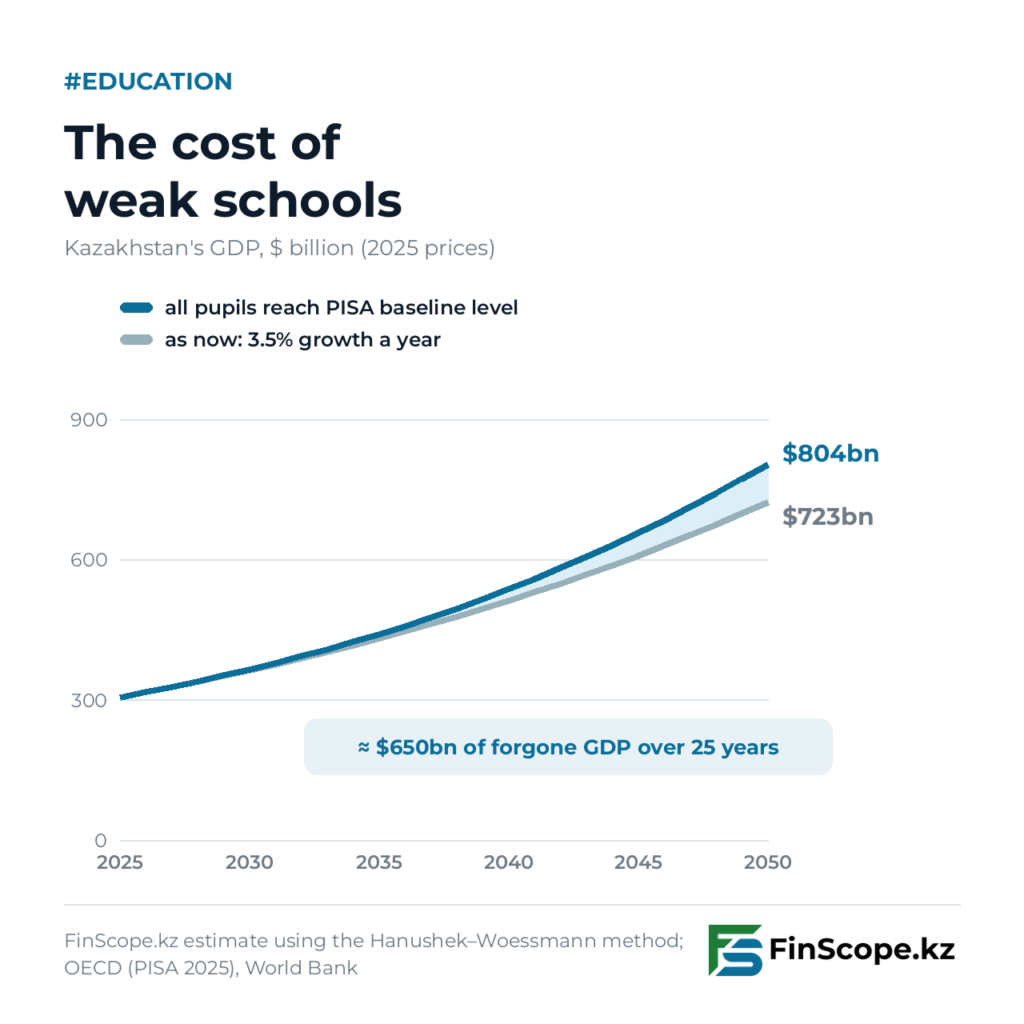
This is not a forecast but an estimate of scale: this is what the economy forgoes because four in ten pupils leave school without basic skills. And by 2050, when Kazakhstan plans to join the world’s 30 most developed countries, it is today’s schoolchildren who will shape the economy.
What needs to change
The infrastructure push has given schools room to grow. The next step is to make pupils’ knowledge the main indicator. Measure not only the number of places but each child’s progress. Publish comparable results by region and type of school, and direct support to where the lag is greatest — above all to rural and small schools. Transfer to ordinary schools not only NIS curricula but also NIS teacher training. And evaluate each reform before launching the next one.
In 2007, Kazakhstan showed that its schoolchildren can be among the best in the world. The question is whether its schools can regain that level — this time for 4 million children.
FinScope.kz newsletter
New articles and data once a week in your inbox. No spam, unsubscribe at any time.