

Everyone’s inflation is different: how much have your expenses risen?
Official inflation in Kazakhstan is 9.2%. But that is the rise in prices of an "average Kazakhstani" basket, and every family's spending is different. We explain why and show how to calculate your personal inflation.
In early November, the Bureau of National Statistics reported that prices in Kazakhstan had risen by 9.2% over the year. But if you ask people you know how much more expensive life has become, the answers will vary widely. Some will say “about the same as usual,” while others will say they are noticeably short of money. And both will be right.
The thing is, official inflation measures the rise in prices of a basket for a hypothetical “average Kazakhstani.” But every family has its own basket: some rent an apartment, some drive every day, some spend most of their money on food. So everyone’s inflation is different.
We analyzed the latest data and built a calculator: enter your expenses, and it will show how much more expensive your own life has become.
Key points:
- Official annual inflation is 9.2%, down from 12.6% a year ago.
- Food prices are rising the slowest (+7.6%), while housing costs are rising the fastest: rent +17.4%, piped gas +34.8%.
- As a result, a family that rents an apartment has personal inflation of about 12%, while a family that owns its home has about 9%.
- You can calculate your own inflation using the calculator below and compare it with inflation in your region.
What is happening with prices
If you break the official 9.2% down into its components, here is what you get:
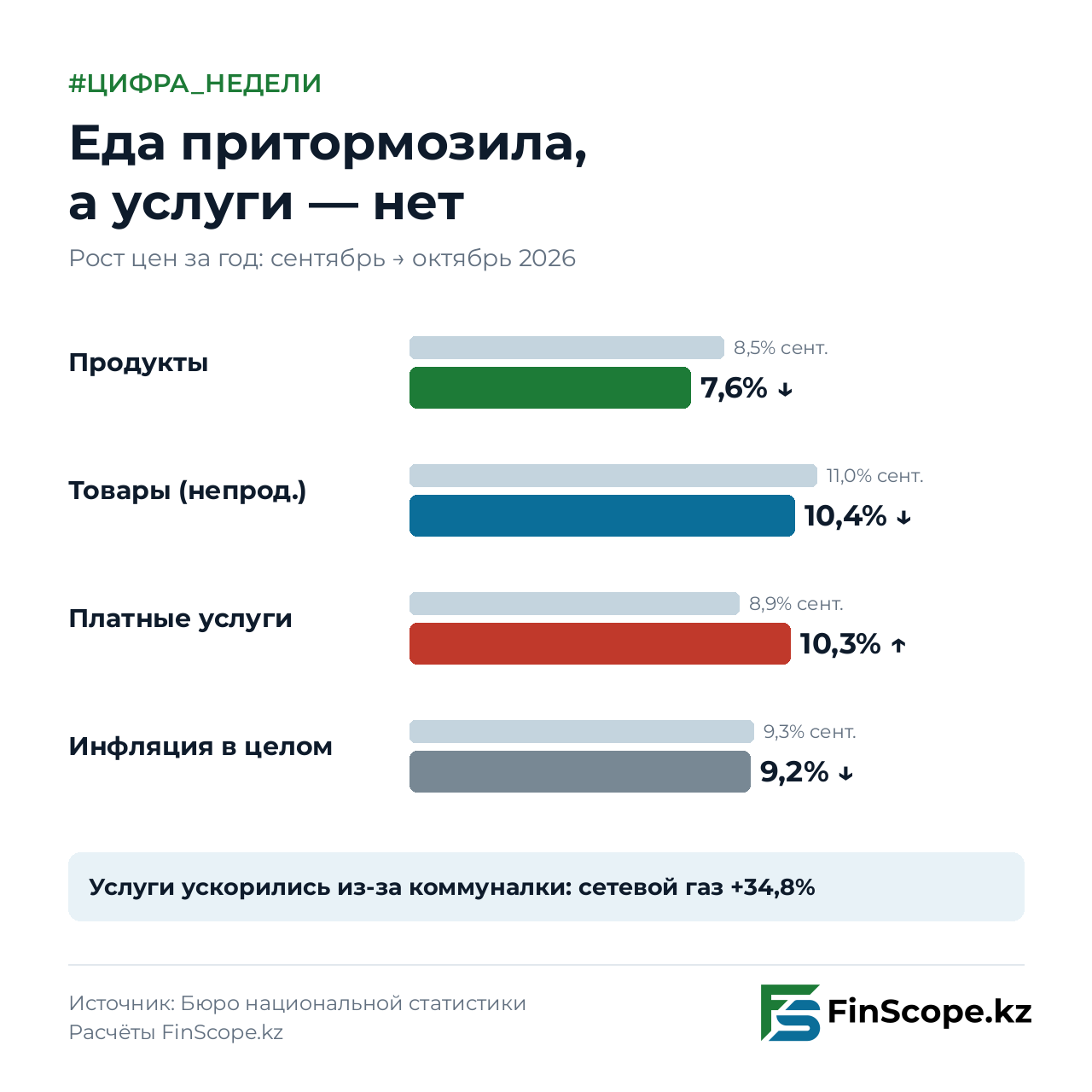
| What | Price growth over the year | Share of the BNS basket |
|---|---|---|
| Food | +7.6% | 41% |
| Clothing, appliances, gasoline and other goods | +10.4% | 28% |
| Services, including rent and utilities | +10.3% | 31% |
| Total | +9.2% | 100% |
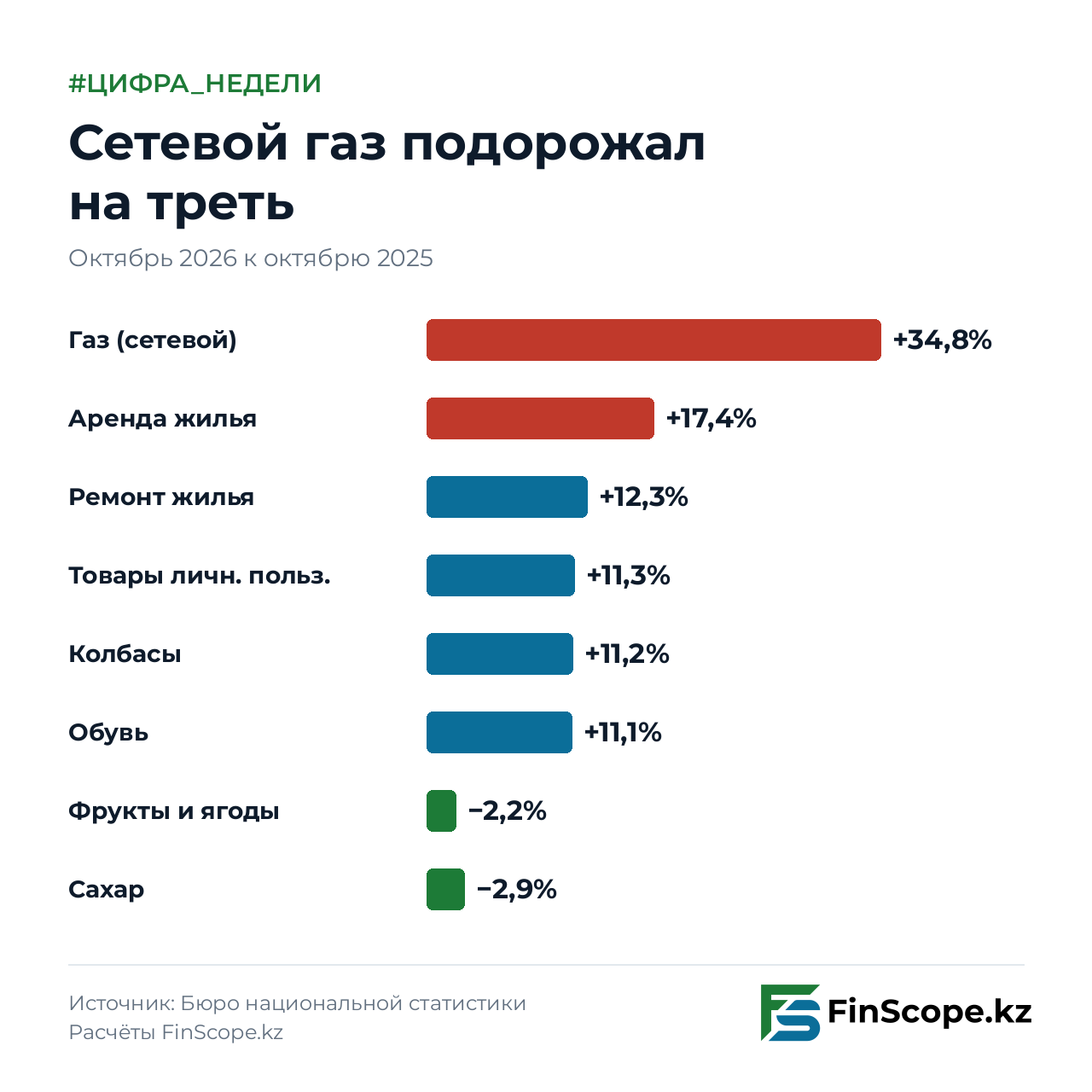
Food is rising the slowest, but it still accounts for a third of inflation. Food prices rose by 7.6% over the year, less than goods and services, and down from +8.5% in September. But food has the largest weight in the basket, so it still contributes about 3 pp of the 9.2%, roughly the same as goods and services. Vegetable prices barely changed over the year (+2.1%), while fruit (−2.2%) and sugar (−2.9%) even became cheaper. Sausages (+11.2%) and eggs (+9.9%) are rising faster than average.
Housing and utilities are among the main sources of price growth. Apartment rents rose by 17.4% over the year, almost twice as fast as official inflation. Piped gas rose by 34.8% (gas overall by 30.2%). This is a low-base effect: in the fall of 2025, Kazakhstan introduced a moratorium on raising utility tariffs, which remained in force until the end of Q1 2026. In October 2025, paid services even became 0.8% cheaper month on month. Prices are now being compared with that low level, so the increase looks sharp.
At the same time, a high percentage does not always mean a big impact on overall inflation. Piped gas added about 0.26 pp to it, and rent about 0.29 pp: these expenses make up only a small share of the average basket. But for a particular family that rents an apartment or heats with gas, this is noticeable money.
Among goods, the fastest price increases were for clothing (+11%), footwear (+11.1%) and personal care items (+11.3%). Gasoline rose by 8.6%, which is slower than average.
9.2%: whose inflation is it?
To measure inflation, the BNS tracks the prices of 537 goods and services across the country every month. It then calculates how much more expensive a basket has become in which 41% is food, 28% is goods and 31% is services. Statisticians take the spending structure from a household survey and average it out.
The problem is that the “average” family does not exist. If you rent an apartment, housing may take up 40% of your budget rather than a few percent, as in the average basket. If you have a car, gasoline takes a noticeable share. So even with the same prices in the shops, inflation turns out differently for different people.
It also varies by region. Prices are rising fastest in North Kazakhstan (10.9%) and Akmola (10.8%) regions. In Astana it is 10%, in Almaty 9.2%, in Shymkent 8.8%. The slowest is Aktobe Region (7.5%). In the calculator below, you can choose your region and compare your inflation with it.
Three families, three inflation rates
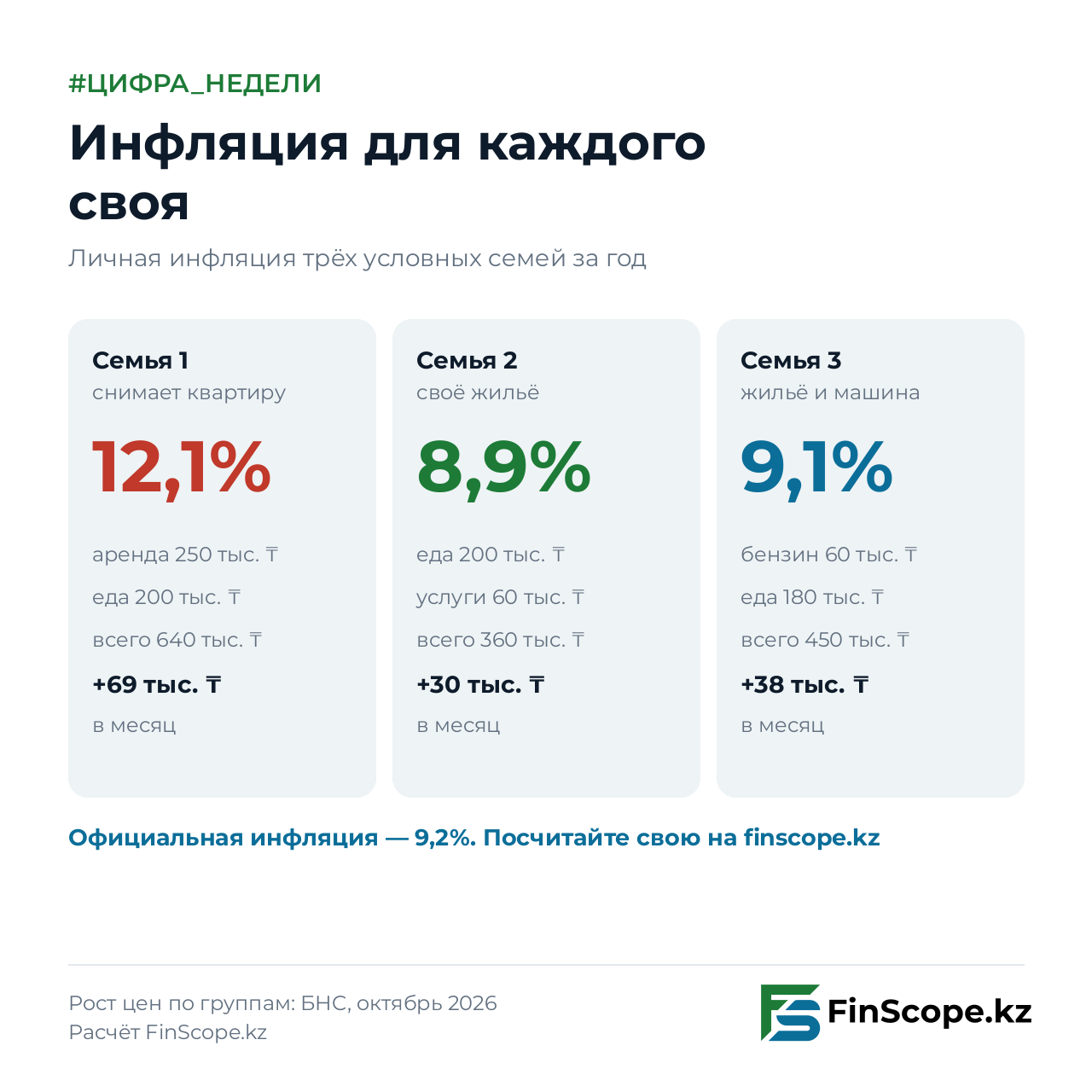
Let’s take three hypothetical families. The first rents an apartment. The second lives in its own home. The third has its own apartment and a car. We took their usual monthly spending and calculated how much the same purchases cost a year ago.
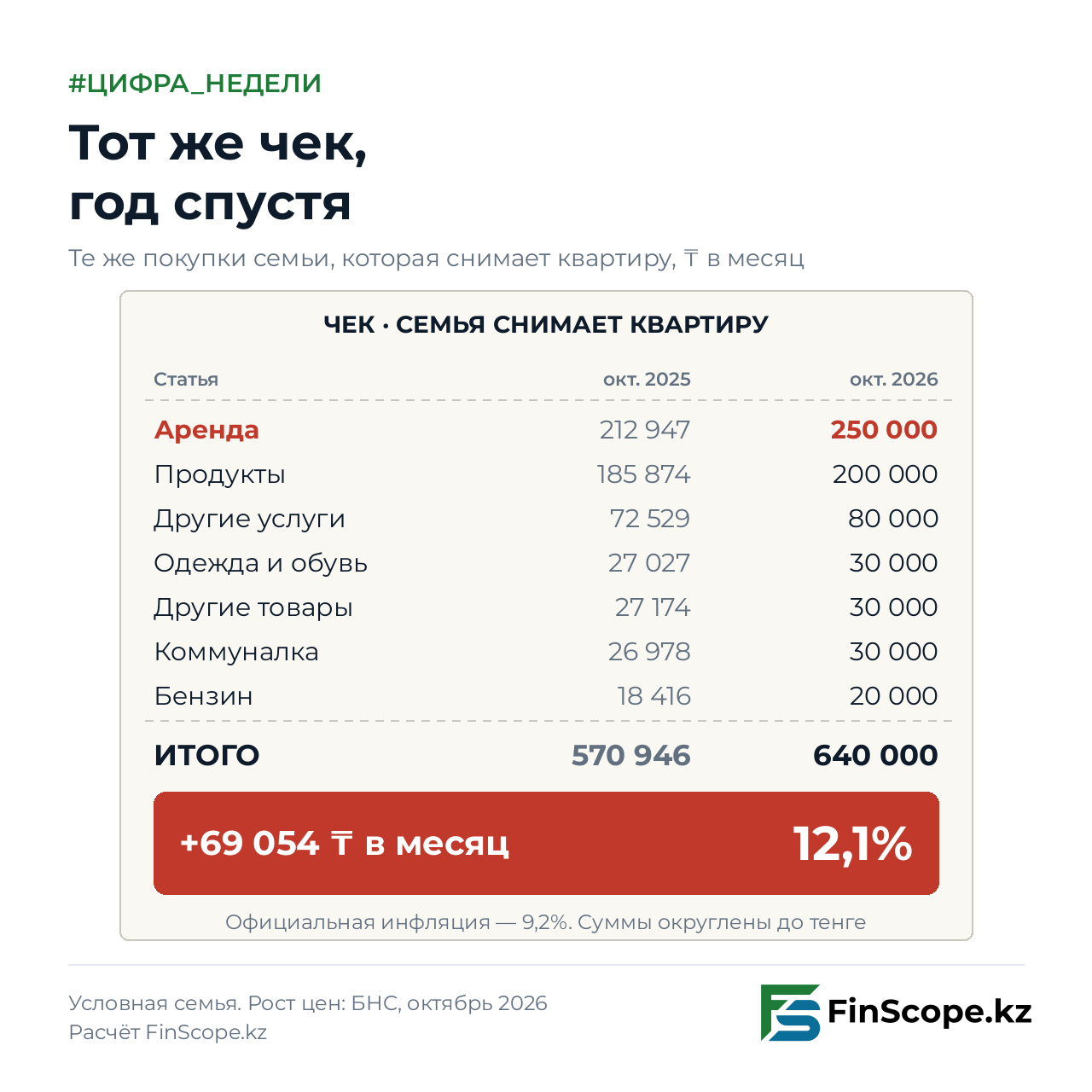
| Family 1: renting an apartment | Family 2: owns its home | Family 3: owns its home and a car | |
|---|---|---|---|
| The same purchases a year ago | 570,946 ₸ | 330,443 ₸ | 412,427 ₸ |
| Now | 640,000 ₸, of which 250,000 is rent | 360,000 ₸ | 450,000 ₸, of which 60,000 is gasoline |
| Personal inflation | 12.1% | 8.9% | 9.1% |
| Extra cost per month | 69,054 ₸ | 29,557 ₸ | 37,573 ₸ |
| What weighs most on the budget | rent: 54% of the increase in spending | food: 48% | food: 34% |
The family that owns its home almost “matches” the statistics: its main expense is food, and food is rising the slowest. A car owner may feel that gasoline is ruining them, but gasoline has risen by only 8.6%, slower than average inflation. Meanwhile, the family that rents lives with inflation of 12.1%, higher than the official rate in any region of the country.
The conclusion is simple: right now, inflation is being driven by housing. For a family with its own apartment, even one with a car, personal inflation is almost the same as the official rate, since gasoline is rising more slowly than average. But for a renter, the same purchases cost 69,000 ₸ a month more than a year ago, or about 830,000 ₸ a year.
Calculate your own
The principle is simple: the larger the share of your budget an item takes, the more its price increase affects your personal inflation. The calculator takes your current spending on each item, works out how much the same purchases cost a year ago (based on BNS price growth for that category), and compares the two amounts.
Enter roughly how much you spend per month, or choose a ready-made example. The calculator will show your inflation, how much money rising prices have “eaten,” and which item is driving up your budget the most. You can share your result.
Enter approximate amounts in tenge. Fill in only what you spend money on and leave the rest blank. Price growth is already filled in based on BNS data; if you know how much your own purchases have gone up, change the percentages.
Enter at least one amount, and your personal inflation will appear here.
Annual price growth based on BNS data, October 2026. The result is an estimate based on average category prices, not an official index. FinScope.kz calculator.
Why 9% feels like more
There is no reason to panic: this is not a crisis or a collapse of the tenge, and in 2022 inflation reached 20%. But many people feel rising prices more strongly than the statistics show. There are three reasons.
- Prices accumulate. Each year is added to the previous one. Over 2023–2025, everything together became about a third more expensive. That is the difference people see on their receipts.
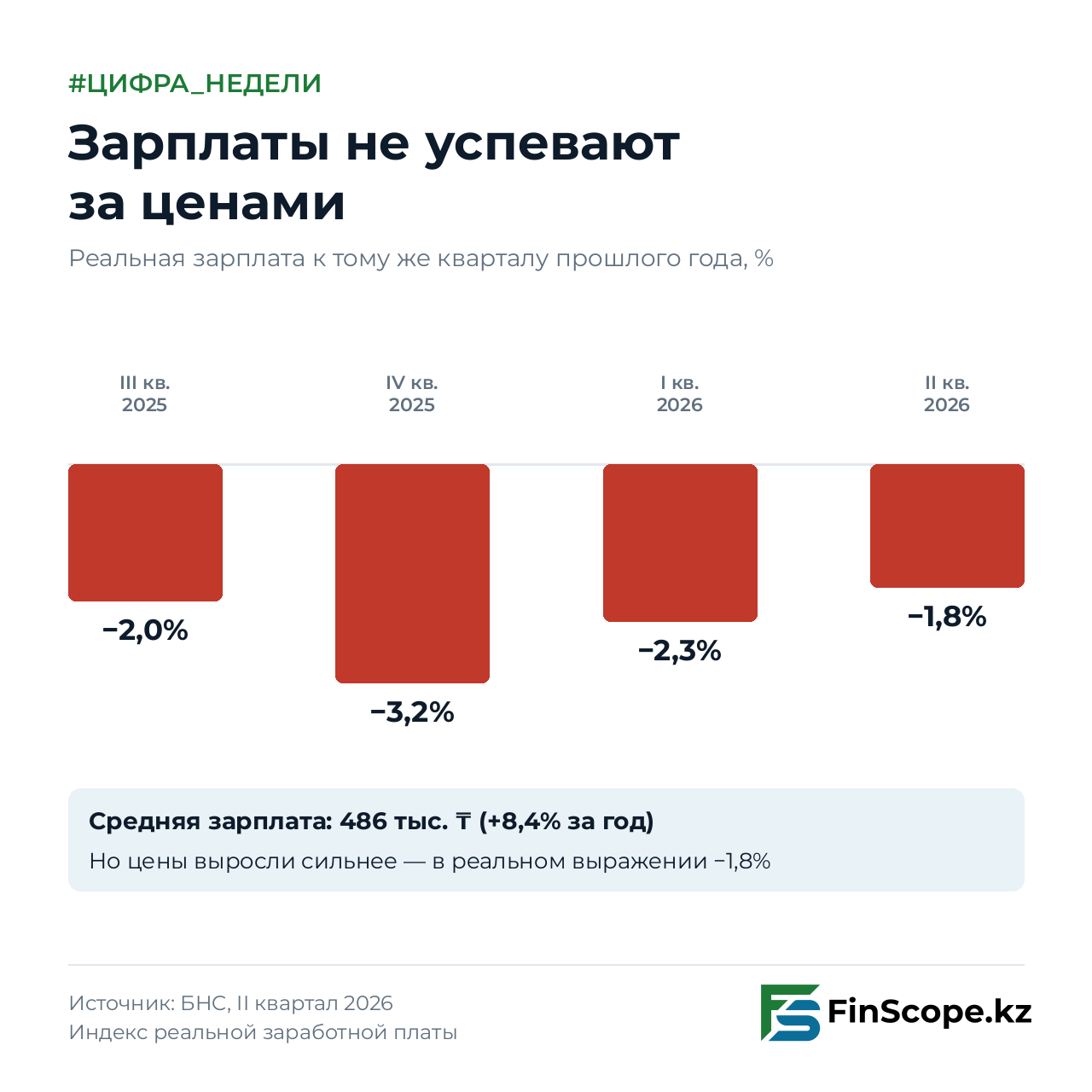
- Wages are rising, but purchasing power is falling. In Q2 2026, the average nominal wage rose by 8.4% to 486,000 ₸. But after adjusting for inflation, the real wage was 1.8% lower than a year earlier. This is already the fourth consecutive quarter in which it has been negative.
- We remember large and regular payments. A bill for rent or gas is more noticeable than apples that have become cheaper.
What you can do
- Find your “expensive” item. The calculator shows what is driving up your budget. Often it is just one or two items, and those are the ones worth working on.
- If you rent, try to agree with your landlord on a fixed price for the year ahead.
- Take inflation into account when choosing where to keep your savings. The nominal return on tenge deposits may now be higher than inflation, but it is worth comparing the effective rate, the term and the conditions for early withdrawal. More details in our analysis of the base rate.
- When negotiating your salary, look at your own inflation rather than the official figure. If yours is 12%, an 8% raise means you are now earning less.
What to expect
Until the end of the year, inflation is likely to stay close to its current level: the effect of last year’s tariffs has not yet run its course. The National Bank expects 9–11% for 2026 and 6.5–8.5% in 2027. The next base rate decision is on December 4. We will update the calculator when new data come out.
FinScope.kz newsletter
New articles and data once a week in your inbox. No spam, unsubscribe at any time.