

Kazakhstan could miss out on $440bn because of weak human capital
Over twenty years Kazakhstan has rebuilt its education and science systems under six strategic documents. There are fewer universities, they are more visible in global rankings, and spending has grown. Yet education has not become an engine of the economy.
Kazakhstan has been building a knowledge economy for twenty years. In that time the country has restructured its universities, adopted international standards, opened its doors to foreign institutions and doubled spending on higher education. There are fewer universities now, and Kazakh universities are more visible in global rankings. But the main question remains open: has education become better at preparing people for a modern economy?
The numbers say not yet. Kazakh schoolchildren lag well behind their peers in OECD countries, science receives several times less money than the government promised, and labour productivity is a third of the EU level. This is no longer a question of diploma quality. A shortage of knowledge and skills hurts wages, the ability of businesses to make sophisticated products and, ultimately, economic growth. By our estimate, if the skills gap with the OECD is gradually closed by 2045, the economy would gain about $440bn over 20 years — and without that, it will miss out on it. We look at what has changed in twenty years, which promises were never kept and where this figure comes from.
Twenty years of reform: what the state promised
Since 2005 higher education and science have been reshaped under six strategic documents: four state programmes, a national project and a concept. Each set ambitious goals.
- The 2005–2010 programme introduced the three-cycle bachelor–master–PhD system and credit-based learning. In 2010 Kazakhstan became the first Central Asian country to join the Bologna Process.
- The 2011–2020 programme promised two universities in the world’s best university rankings by 2020 and autonomy for all universities.
- The 2016–2019 programme made this more specific: two universities in the QS top 200 by 2019.
- The 2020–2025 programme was the first to set out a year-by-year path to the main goal for science — 1% of GDP by 2025 — and added three universities in the top 200.
- The national project “Educated Nation” kept the ranking target.
- The current document is the Concept for the Development of Higher Education and Science for 2023–2029: science spending of 1% of GDP is now expected by 2029, and businesses are supposed to provide half of research spending.
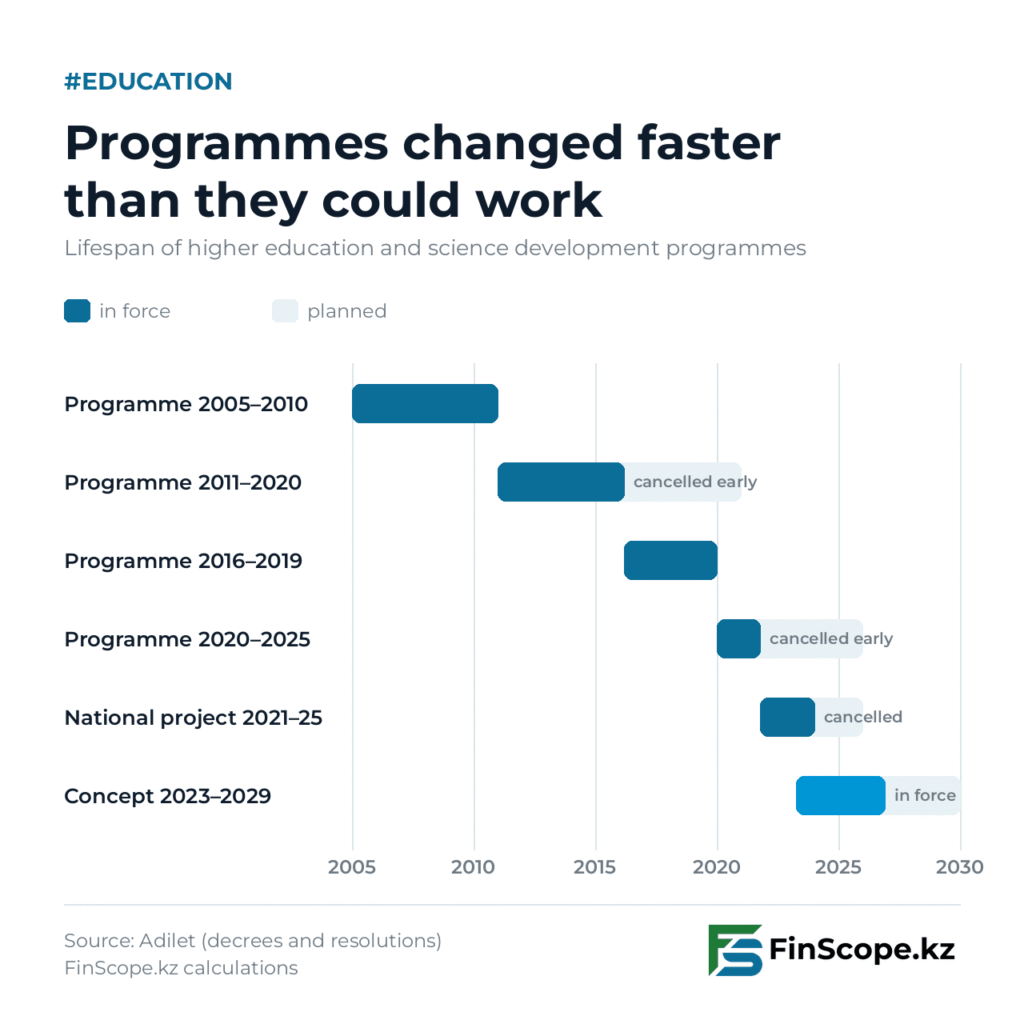
Only two programmes ran their full term — 2005–2010 and 2016–2019.
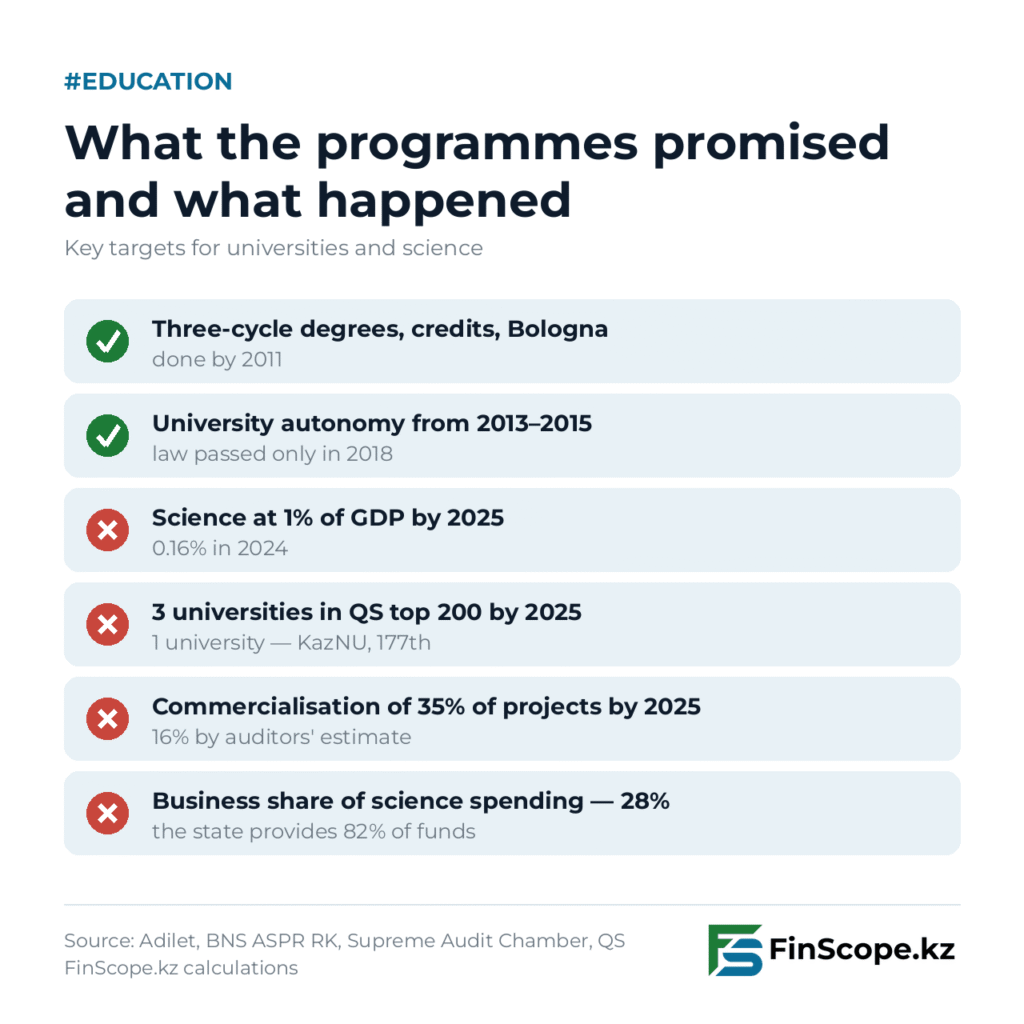
The 2011–2020 programme was replaced in 2016, the 2020–2025 programme less than two years after it began, and the national project lost force from 2024 before reaching its end. Targets were rewritten before anyone could report on them: autonomy for universities was promised from 2013–2015, but the law was passed only in 2018; the goal of “1% of GDP for science” moved from 2025 to 2029.
What has changed
It would be unfair to say the reforms achieved nothing. The clean-up of the market worked best. In the 2005/06 academic year there were 181 universities plus dozens of branches; today there are 132. Distance learning by correspondence was abolished, universities now set up to 80% of their curricula themselves, and 27 large state universities became non-profit joint-stock companies.
Universities have become more visible internationally: in 2015 the QS ranking included nine Kazakh universities, in the latest edition 18. The share of foreign students rose from 2.5% to 7%, and branches of foreign universities have come to the country. Spending on higher education almost doubled in five years, from 246bn to 472bn tenge.
But these are reforms of form: structure, rules, numbers. The main substantive promises — world-class universities, science at 1% of GDP, research funded by business — have not been delivered.
Why education has not become an engine of the economy
Human capital is built along a chain: school provides basic knowledge, university turns it into qualifications, and the labour market turns it into experience and productivity. There are weak links at every stage.
1. School: the foundation is sagging
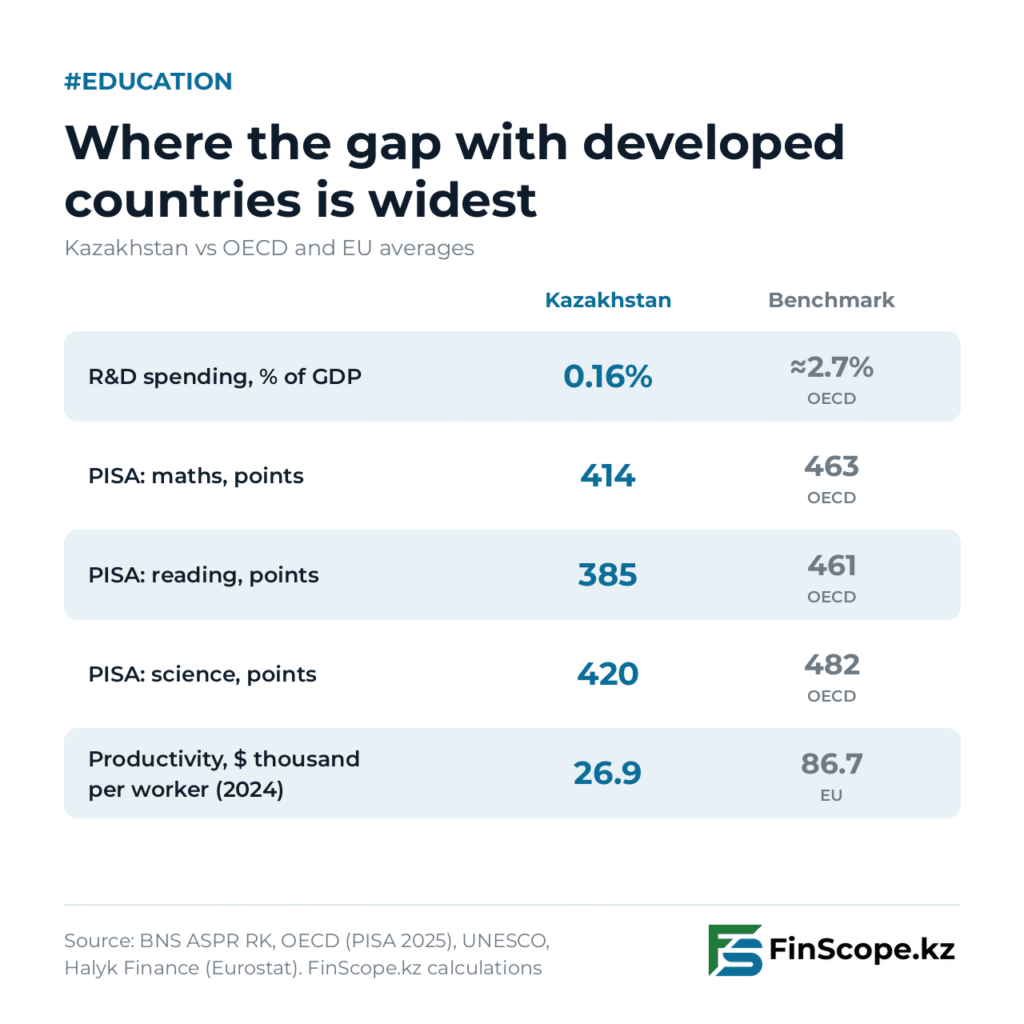
In PISA 2025, Kazakh 15-year-olds scored 414 points in maths against an OECD average of 463, 420 in science against 482, and 385 in reading against 461. And results are not just stagnating: compared with 2022, maths fell from 425 to 414 points, while reading barely changed. In 2014 Kazakhstan set itself the goal of entering the top 30 countries in such tests — today that goal is further away than it was then. Universities recruit students from this pool, and four years of a bachelor’s degree cannot close the gaps left by school. We will look at the school system in more detail in our next article.
2. Universities: money follows places, not results
Higher education received twice as much money, but according to the Supreme Audit Chamber it “does not deliver a comparable increase in quality”. State grants are allocated by the number of places, not by what students have learned. In 2022–2024 about 24,000 grant-funded students were expelled after 19.6bn tenge had already been spent on them, and grants still go even to universities where graduate employment is below the threshold.
World-class universities have not appeared. The target of two universities in the top 200 was set for 2019–2020, and three for 2025. Today there is one Kazakh university in the QS top 200 — al-Farabi Kazakh National University (KazNU), in 177th place — and that position is fragile: in the 2024 ranking it fell to 230th. In the QS Asia ranking, Kazakh universities score an average of 3.8 points for citations, against an Asian average of 35.2.
3. Science: promised 1% of GDP, got 0.16%
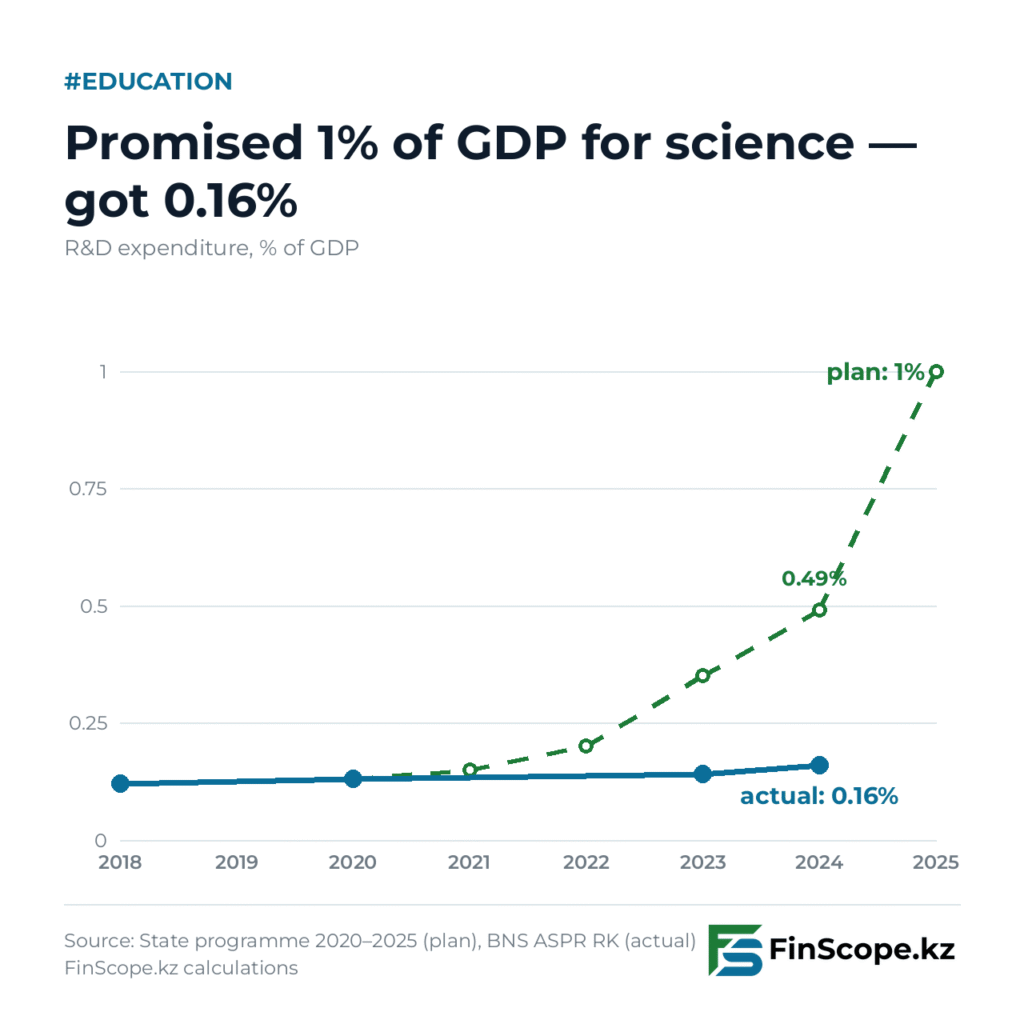
The goal of spending 1% of GDP on science has migrated from document to document for more than a decade. The 2020–2025 programme assumed that the share would reach 0.49% in 2024. In reality it was 0.16% — a third of the plan and a sixth of the target.
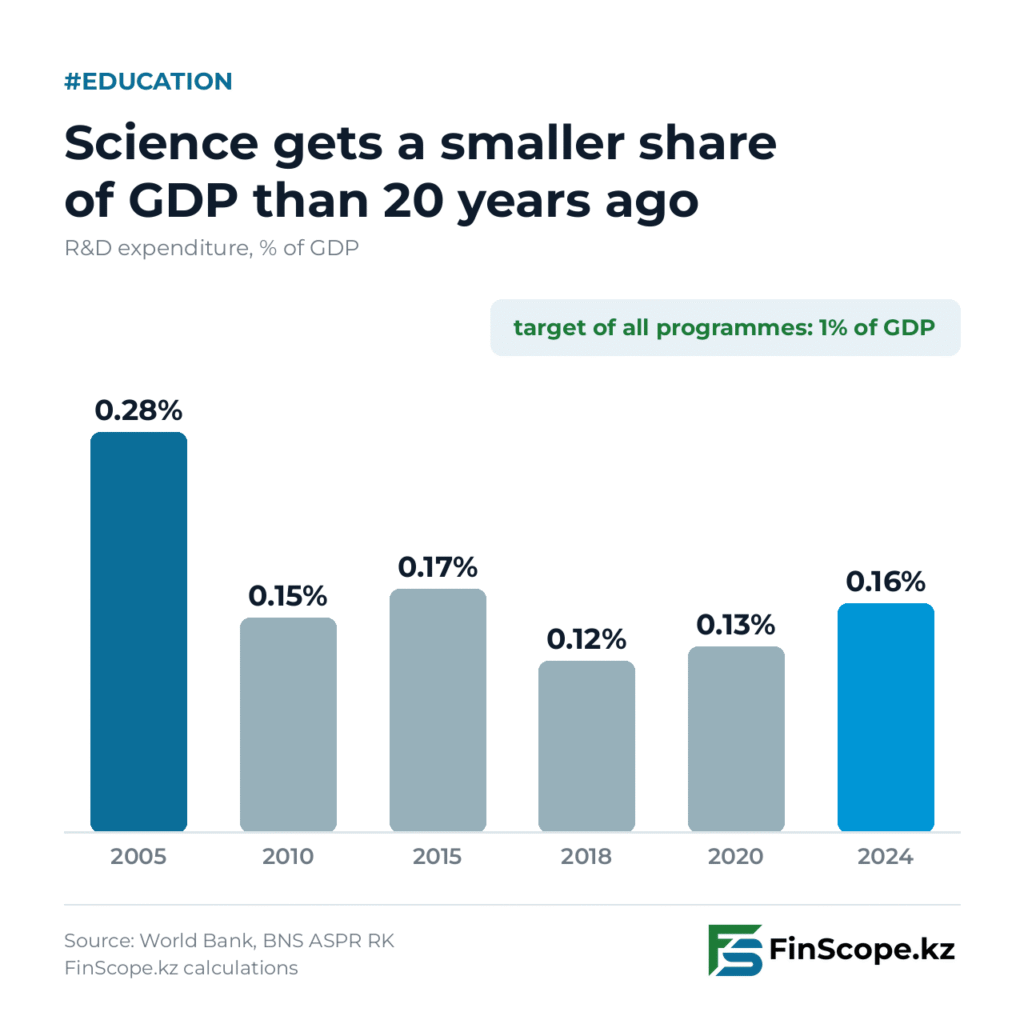
Twenty years ago science received 0.28% of GDP — almost twice as much as now. In money terms funding is growing: in 2025 R&D spending reached 261bn tenge. But the economy grew faster. For comparison, OECD countries spend on average about 2.7% of GDP on research, and the 2014 “Top 30” Concept promised to raise Kazakhstan’s share to 3% by 2050.
The main problem is who pays. The programmes counted on business providing between half and two thirds of science funding. The opposite happened: according to the auditors, the state’s share rose from 55% to 82%. Business does not see a product in Kazakh science: by the auditors’ estimate, only 16% of projects are commercialised. In November the auditors found violations worth 51bn tenge in science spending, and 84 of the 225 members of the national science councils had themselves taken part in projects those councils approved.
4. Labour market: plenty of diplomas, little return
There is demand for educated people in Kazakhstan: according to the Bureau of National Statistics, workers with higher education earn an average of 523,000 tenge a month, 68% more than those with secondary education. But knowledge often fails to reach the workplace. Of roughly 20,000 IT graduates a year, only 30% work in their field, and back in 2019, 70% of employers were dissatisfied with graduates’ skills.
This matters more than it seems. Remi Jedwab, Nobel laureate Paul Romer, Asif Islam and Robert Samaniego studied more than a thousand household surveys and census samples in 145 countries. In a paper published in the American Economic Journal: Macroeconomics in 2023, they showed that in rich countries each year of work experience raises earnings by 3.2% on average, compared with 1.7% in low- and middle-income countries. Workers in developed countries accumulate roughly twice as much human capital on the job, and the contribution of experience to income may be comparable to that of education. When a graduate spends years working outside their field, the country loses both the money spent on their education and the experience they could have gained.
The result of the whole chain shows up in productivity. In 2024 one employed person in Kazakhstan produced about $26,900 of output, compared with $86,700 in the European Union — more than three times as much. The gap is wide even in the extractive industries where Kazakhstan has an advantage.
How much Kazakhstan is losing
Economists Eric Hanushek and Ludger Woessmann, studying data from dozens of countries over forty years, showed that growth rates are better explained by what people actually know and can do than by years spent in school. By their estimate, a difference of 100 points in international tests is associated with roughly two percentage points of faster growth in GDP per capita a year.
Kazakhstan trails the OECD in maths and science by an average of 55 points. Applying the Hanushek–Woessmann estimate to this gap implies roughly 1.1 percentage points of additional growth a year in the long run. This is not a forecast for Kazakhstan’s economy: growth also depends on investment, institutions, competition and economic structure. But the calculation shows the scale of the possible return from better education.
Skills also improve gradually: first the system has to change, then new generations have to enter the labour market. So we calculated three scenarios in which the effect builds up over time. The World Bank expects economic growth to slow to about 3.5% a year — this is the baseline with no improvement.
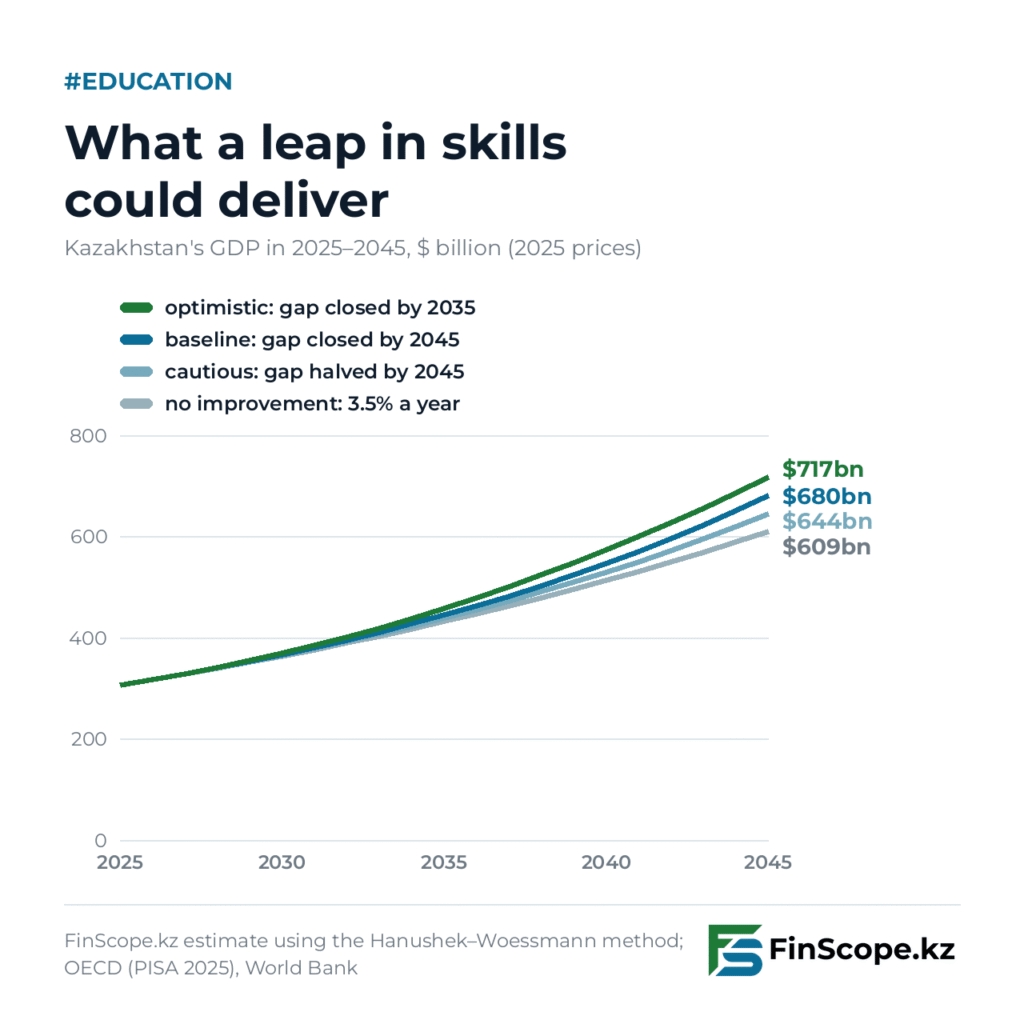
- Cautious scenario: the gap with the OECD halves by 2045. GDP in 2045 is $35bn, or 6%, higher, and over 20 years the economy gains an extra $220bn or so.
- Baseline: the gap gradually closes by 2045. GDP is $72bn, or 12%, higher, and the cumulative gain over 2026–2045 is about $440bn. That is how much Kazakhstan could miss out on if nothing changes.
- Optimistic: the gap closes within ten years. GDP in 2045 is $108bn, or 18%, higher, and the cumulative gain is about $760bn — two and a half times today’s annual GDP.
There is also a link to the country’s main political goal — joining the 30 most developed countries in the world by 2050. The 2014 Concept that spelled out this goal assumed it would require growth of about 4.3% a year. In our calculation, average growth over 20 years reaches that level only in the optimistic scenario. Without a leap in the quality of skills, the “Top 30” goal becomes less and less realistic.
The World Bank also estimates the loss at the level of individuals: if education, health and employment were brought up to the level of the best countries with similar incomes, the earning potential of Kazakhstanis would rise by 41%.
What needs to change
The system will change again in the coming years: from 2027 a new admission test, AIT, developed by the US-based ETS, will be piloted for teacher-training programmes, and the Unified National Test (UNT) will be updated until 2029. After the auditors’ review in November, part of the ministry’s leadership has changed. But twenty years of experience suggest that a seventh document will not change anything on its own.
Universities and scientists need to be paid for results — what graduates know, what they earn, real research output. Grants need to be allocated without conflicts of interest. Study needs to be linked to work so that graduates build experience in their field. And the course needs to be held long enough for reforms to take effect.
Kazakhstan can talk as much as it likes about diversification, high technology and the knowledge economy. But none of this is possible without people who can create technologies, run complex production, conduct research and raise business productivity. The main result of reform is measured not by the number of foreign university branches, nor by a place in the QS ranking, nor even by budget spending. It is measured by what graduates know and can do and by the value they create. How well Kazakhstan handles this stage will determine not only the future of its universities but also whether the country can move from a resource economy to an economy of productivity and knowledge.
FinScope.kz newsletter
New articles and data once a week in your inbox. No spam, unsubscribe at any time.